Each week, I devote part of my Sunday to reading. I tend to accumulate a lot of saved links on Facebook during the week, and I like to try to keep up with what fellow writers are posting here on WordPress. At the end of my reading day, I like to put up a post to draw my readers’ attention to a few articles I found to be of particular interest.
Here’s what I enjoyed this week:
First tetrapods of Africa lived within the Devonian Antarctic Circle
by Robert Gess, Albany Museum, Grahamstown, South Africa (provided by Phys.org)
One of my favorite things about Phys.org is the site’s access to raw science like this. We’re in for a treat this week: the article above is not an article; it’s a scientific paper, taken directly from the journal Science, and it details a remarkable discovery concerning the evolution of terrestrial fauna on Earth.
During the Devonian period, the nature of life on Earth changed forever. With complex plants stabilizing freshwater wetlands, Earth’s building estuaries became a vital ecosystem, and to fill new ecological niches, certain species of fish began to evolve rudimentary legs. Thus, the tetrapods were born, leading to the first notable radiation of terrestrial vertebrates. This translated to a sudden explosion of life on Earth’s landmasses.
These early tetrapods were unlike most any lifeforms left on Earth today, often taking the form of an odd halfway point between an amphibian and a fish. Eventually, they would develop into the more recognizable large amphibians of the Carboniferous period. But while they may not bear much resemblance to animals of today, in time the evolution of these strange creatures would lead to all land vertebrates we see today, including us.
Until recently, however, fossils of these early tetrapods were concentrated primarily in areas located around the equator and surrounding tropics during the Devonian. But now, Gess and his colleagues have rewritten the book on tetrapod evolution, by discovering the first early tetrapods in Africa.
During the Devonian period, Earth was a very different place, not only ecologically but geographically as well. What is now Africa was, at the time, part of the supercontinent Gondwana, and lay within the Antarctic circle. Prior to Gess’s discovery, the only evidence of early tetrapods on Gondwana had been found in Australia.
The discovery is groundbreaking in that it calls our understanding of early tetrapod radiation into question. While previous finds had led to the general understanding that tetrapods first evolved around Earth’s tropics, this new discovery suggests life’s gradual shift from water to land occurred everywhere at roughly the same time.
Reports of sterile neutrino’s resurrection may be greatly exaggerated
by Adrian Cho, Science
This week, the scientific community was abuzz after new research suggested the existence of a fourth form of neutrino. The discovery has the potential to turn the field of particle physics on its head, but as Adrian Cho writes for the journal Science, evidence of this particle has existed since the 1990s, and may remain far more tenuous than all the headlines suggest.
A neutrino is an almost massless subatomic particle. As they only interact through the weak nuclear force, they seldom interact with other matter, and these two things make them notoriously difficult to detect. Through the use of a setup involving particle stream emitters and distant particle detectors, however, scientists have been able to detect neutrinos, and have thus identified three: electron, μ, and τ, named for the particle interactions that create them. A neutrino of one form can morph into another through a process known as oscillation, and the recent study mentioned earlier suggest that neutrinos may be capable of morphing into a fourth form, known as a sterile neutrino.
The evidence for the existence of these sterile neutrinos takes the form of three studies, the most recent of which was conducted recently, all of which observed an apparent discrepancy in the number of anitneutrinos formed during an experiment. This discrepancy could be explained by the existence of a fourth form of neutrino, which would produce additional unexpected oscillations, resulting in more anitneutrinos.
Of course, the discrepancy could also be explained in other ways. While theorists who support the existence of the sterile neutrino note that nuclear reactors tend to produce roughly 6% fewer electron antineutrinos than expected, a team of physicists from Shenzhen, China, suggested last year this discrepancy could be resolved if theorists had simply overestimated the number of antineutrinos produced by uranium 235, the standard fuel of nuclear reactors. What’s more, in 2013 researchers with ESA’s Planck spacecraft released an extremely precise measurement of the Cosmic Microwave Background (CMB): the afterglow of the Big Bang. While previous, less precise measurements had left room for a fourth neutrino, the Planck measurements indicated only the three forms known to exist.
To the casual science reader, this article might feel like something of a wet blanket: rather than excitedly embracing a new theory, the author spends an entire article poking holes in it. However, I included this article because it perfectly illustrates the process of science. Despite our access to information, unparalleled in the history of our species, the average person today tends to hold an unrealistically cut-and-dry understanding of how science works. At its best, science is a form of order that arises from chaos, and it’s safe to say that being wrong is just a part of the process. The same, safe to say, is true of life.
Ancient Native American King’s House Rediscovered in Florida
by Megan Gannon, National Geographic
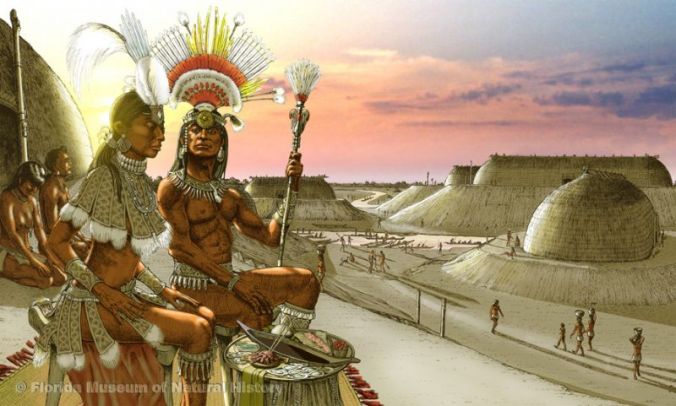
An artist’s depiction of Caalus, ruler of the Calusa civilization. Photo from the Florida Museum of Natural History, which was responsible for the study.
In this fascinating article, Megan Gannon of Nat Geo writes of something you don’t hear about very often: a thriving native kingdom that once existed in North America.
Our general understanding of human development holds that complex societies…civilizations…develop as a result of agriculture. It makes logical sense: all of the hallmarks of civilization are required in an agricultural community. Hierarchy develops through the delegation of labor. Infrastructure, roads and storage structures and the like, arises from the need to streamline production and transportation of food. The distribution of food requires a rate of exchange, while keeping track of production requires tabulation and record keeping. Early religions often revolved around rainfall, flooding, and crop cycles. And agriculture leads to a well-fed society, requiring more and better housing to accommodate a growing population.
Yet all our preconceived notions of civilization are challenged by the Calusa civilization. Centered around Mound Key, now an overgrown island just south of Fort Myers, Florida, at their peak the Calusa numbered in the tens of thousands, with large structures including the king’s residence: an 80 by 65-foot structure supported by 150 individual wooden posts. All of this was supported by a civilization centered around fishing, with a diet supplemented by wild game. The closest the Calusa appeared to have gotten to agriculture was the trend of maintaining private vegetable gardens, where they grew chili peppers, papaya, and gourds.
It’s remarkable that a fisher-hunter-gatherer society managed to build a complex, thriving civilization that stood for at least 500 years, and only fell, as so many indigenous cultures did, amid population pressures from European colonial powers. And even then, given the horror stories recounted by Spanish conquistadors, they held out far longer than most.
Knowledge is power. Take time out to read a bit every day. It’s your window into the world around you. – MK
 Michael T. Kuester