Most modern weapons have one major drawback: ammunition. It’s the great limiting factor of chemically-propelled weapons (firearms). Weapons that require bullets or other projectiles are expensive, requiring a constant stream of bullets, rockets, missiles, et cetera. They’re dangerous to their operator, potentially backfiring or misfiring. And they’re messy: bullets rip holes in flesh, bombs and missiles explode, potentially causing the sort of collateral damage modern society wisely deems unacceptable.
An ideal future would be one without war, where weapons of any kind are unnecessary. But we do not live in an ideal world. Disagreements are inevitable, and for better or worse it’s unlikely we’ll ever advance to a point where disagreements cannot turn deadly. Thus, the calculus of modern warfare calls for a minimalist approach. Modern warfare is targeted, clean and efficient. And it requires precision weaponry, capable of hitting military targets while sparing innocent bystanders. In short, modern warfare requires a new kind of weapon, one ripped from the pages of science fiction.
It’s safe to say that, in warfare, energy weapons are the future. They’re inexpensive, clean, and efficient, allowing precision targeting without the potential to harm civilians. A modern laser weapon can easily accomplish what any bomb can, without the mess and horror.
For the world at large, the rise of directed-energy weapons is the next-best thing to the end of war itself. But for the sci-fi writer, the leap of energy weapons from fiction to reality once again leads to more discerning readers, who demand realism from science fiction. So, how can the modern sci-fi writer accurately depict something that has become such an obvious trope?
Energy Weapons in Science Fiction

The energy weapon may be the oldest surviving trope in science fiction, predating faster-than-light travel and artificial gravity. Thoughts of early sci-fi invariably conjure images of heroes in shiny suits, armed with “ray guns” to battle the aliens. From Star Trek to Star Wars and everything in between, energy weapons have been a staple of science fiction. The method varies: the most notable example, Star Trek‘s phaser, is said to produce a stream (or electromagnetically-condensed burst) of exotic (and fictional) particles. But today we live in a world where energy weapons are no longer fantasy: they are reality.
Energy Weapons in Reality
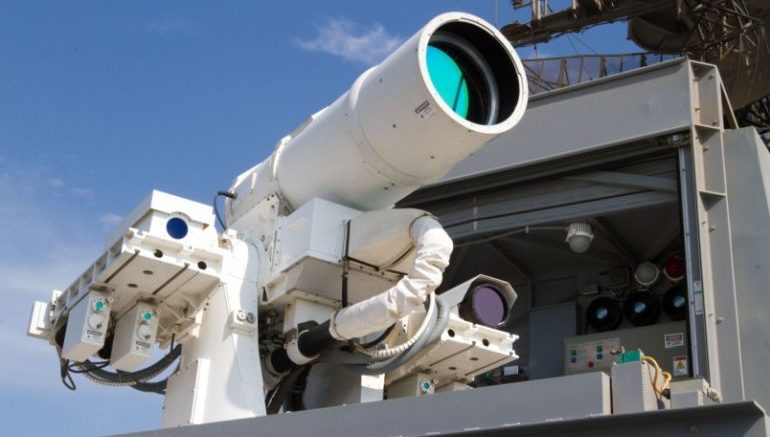
Today, energy weapons are exemplified by the laser cannon. Practical laser weaponry became possible in the late 1990s, when scientists developed a now-standard drum design utilizing focusing mirrors. These mirrors prevent energy loss at range by focusing the beam inward, rather than allowing photons to scatter. The result is a pinpoint beam of searing energy.
Laser weapons operate by generating intense heat, either melting or incinerating a target. When employed against enemy vehicles, the goal is not to destroy the vehicle so much as render it inoperable, typically by melting the engine block.
There are a few important caveats to current laser weaponry. The first is their purpose: at present, no existing laser weapon systems are designed for antipersonnel applications. Rather, a laser weapon is designed as an anti-vehicle system, for use primarily against drone aircraft, armored vehicles, and ballistic missiles. The second is that they have limits. As lasers are simply a highly-condensed beam of light, laser beams are subject to a phenomenon known as thermal blooming, in which a medium (air, for instance) absorbs some of the beam’s energy, distorting and weakening it. For the sci-fi writer, it should be noted that thermal blooming is moot in a vacuum, which would make laser weapons far more practical in space than in atmosphere.
Science fiction fans expecting a real-life phaser would be disappointed by the modern laser cannon. As it is simply a beam of light, a laser beam emits no sound. In fact, under normal circumstances the beam itself would be invisible. Only some obscuring medium, such as dust or smoke, would allow the beam to be seen. And due to thermal blooming, such obstructions would also reduce the effectiveness of the weapon.
Science still has some kinks to work out before energy weapons become ubiquitous on the battlefield. But it’s safe to say we’re close. That means science fictions writers need to understand how these weapons work, and how to portray them accurately for a higher caliber of reader. – MK

 Michael T. Kuester