Slipstream has become one of the most popular genres in science fiction over the past several years. For those who may be unfamiliar, a slipstream story tells the alternate history of a version of our world where some major event played out differently (creating a point of divergence). Until now, arguably the most widely-known slipstream series was Amazon’s The Man in the High Castle. But now, Apple TV+ has created a very different story, based on a single question:
What if the Soviets had made it to the moon first?
The answer, provided by longtime sci-fi innovator Ronald D. Moore, has evolved into an alternate history in which the space race never ended, the Soviet Union never fell, and space travel became the driving force of humanity. Despite its opening premise, For All Mankind has developed into a surprisingly hopeful vision of not only what humanity could have been, but also what it could still become. The result is one of the best sci-fi series ever written, anchored by an incredible cast, an engaging story, and the kinds of special effects that have come to define modern science fiction.
Now that it’s wrapped up its fourth season, let’s take a closer look at For All Mankind in this month’s “Sci-Fi Reviewed”: the story so far, what the critics think, and how Moore and company made For All Mankind a perfect sci-fi parable for today.
The Premise
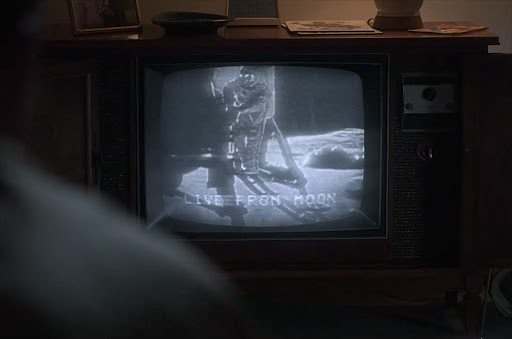
For All Mankind opens on what is a chilling note for American viewers: in 1969, the nation watches on television as cosmonaut Yuri Andropov takes humanity’s first steps on the moon. From there, things slowly diverge, as the space race continues well into the early 21st century.
Initially, the story revolves around three primary characters: Apollo astronauts and best friends Ed Baldwin (based loosely on real-life astronaut Thomas P. Stafford) and Gordon “Gordo” Stevens (based loosely on real-life astronaut Gene Cernan), and engineer Margo Madison (based on real-life NASA engineer Margaret Hamilton). That core of characters is joined by a wide range of historical figures, including the Apollo 11 astronauts (Neil Armstrong, Buzz Aldrin, and Michael Collins), NASA flight director Gene Krantz, head of the astronaut office Deke Slayton, rocketry expert Wernher von Braun, and even President Richard Nixon.
But from there, the show begins jumping through time. For All Mankind is a generational story, largely following the Baldwin and Stevens families and how their lives develop in this alternative timeline. Through it all, the show also depicts how the United States, and the world on the whole, change, including extensive use of voice impersonators and masterfully-altered archival footage of everyone from Ted Kennedy (who defeats Nixon in the 1972 Presidential Election) to Ronald Reagan (who becomes president in 1976) to Soviet leader Mikhail Gorbachev (who leads the USSR through the early 2000s) and astronaut Sally Ride (the principle designer of NASA’s NERVA nuclear rocket engine).
The Story So Far
Warning: spoilers ahead!
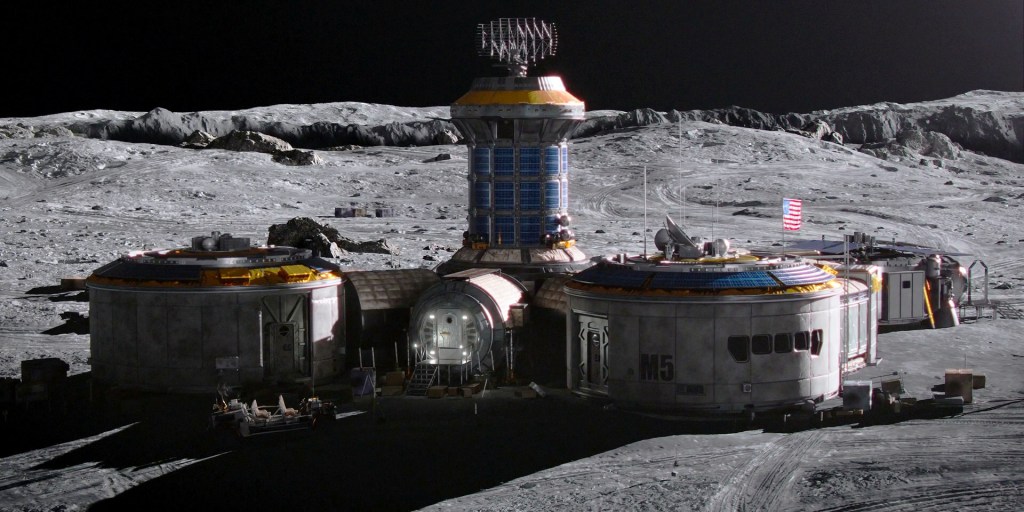
Following the first season, each successive season has begun roughly nine years after the previous one. By the end of the first season (in the mid-1970s), both the United States and the Soviet Union have formed permanent bases on the moon. By the start of season two, which takes place during the 1980s, the US Jamestown Base has been expanded significantly, with crews being ferried between Earth and the moon by a large fleet of space shuttles. Season three, set mostly in the mid-1990s, focuses on the US and the Soviet Union racing to land on Mars. Season four, which takes place in the early 2000s, mostly revolves around humanity’s first attempts at asteroid mining.
As the series progresses, characters age, with some departing the show, and in all cases younger characters seamlessly assume their roles in the story. Midway through the first season, new characters Danielle Poole and Molly Cobb join Tracy Stevens (Gordo’s wife) as members of the first female astronaut class. Cobb and Poole become major characters in the subsequent seasons, with Poole taking Gordo’s role after he and Tracy sacrifice themselves to save Jamestown at the end of season two.
Season two introduces the next generation of the show’s main families: Kelly Baldwin (Ed and Karen Baldwin’s daughter, adopted from Vietnam) and Danny Stevens (oldest son of Gordo and Tracy). Aleida Rosales, a Mexican girl brought to the US illegally as a teenager, becomes Margo’s protégé, just as Margo was mentored by Wernher von Braun. As of the most recent seasons, Kelly and Danny have become astronauts (with Danny dying on Mars under mysterious circumstances in the 1990s), while Aleida has become a leading NASA engineer, following in Margo’s footsteps.
After season two revolves primarily around a nuclear standoff amid disputes between the US and the Soviets on the moon in the 1980s, season three deals primarily with the two superpowers racing to Mars, ultimately landing jointly after the US crew (led by Danielle Poole) rescues the Soviet crew when their reactor melts down. As of the latest season (season four), the United States and USSR have become leading members of the Mars Seven Alliance (abbreviated M-7; For All Mankind‘s equivalent of the former G-8). As the show has now progressed to the 2000s, the remaining original characters (Ed, Danielle, and Margo) have been supplanted by younger characters like Kelly and Aleida, who are now driving the story.
The Reaction So Far

Thus far, For All Mankind has been an overwhelming critical success. Critics have praised not only the show’s story and acting, but also its hopeful vision of humanity (some critics have argued that For All Mankind‘s story is the history we all wish was true). Furthermore, recent seasons have garnered praise for the incredible range displayed by its core cast. As the series has progressed, many of its main actors have been called upon to play characters who have aged greatly since it began. Joel Kinnaman, the Swedish actor who plays Ed Baldwin, now portrays an American grandfather in his seventies. Coral Peña, who portrays Aleida Rosales, has spoken about the challenges of being a millennial woman in the role of a baby boomer.
All in all, since its premiere in 2019 For All Mankind has been nominated for fifteen awards and won four: two Primetime Emmys (2021, 2024), a Saturn Award (2021), and an award for innovation from the Producer’s Guild of America (2022).
My Take
Anyone who reads my website, or my work, knows that science fiction is one of my passions. I’ve long considered myself a connoisseur of science fiction. But throughout my life, my greatest passion has always been space exploration. And because of that, I regard For All Mankind as one of the greatest masterpieces of space sci-fi. Not only is the science sound, including incredibly faithful depictions of actual NASA operations, but it feels more like a classic sci-fi series; while the special effects are excellent, the show doesn’t rely on them. In an era where many sci-fi series and films lean on eye-popping CGI, For All Mankind prefers to focus more on the personal lives of astronauts and NASA engineers; their families, their friends, their relationships, and their struggles.
In many wonderful ways, For All Mankind feels like a love letter to NASA. It depicts the risks of space travel, and the sacrifices of astronauts. And it repeatedly stresses that these sacrifices are to be honored, not avoided. That the conquest of space is worth any risk, and that the benefits outweigh the risks. Throughout the series, though politicians endlessly debate the merits of space exploration, the astronauts never waver. It sends the message that everyone needs to hear about space exploration: that no price is too high, and that the journey, the pursuit of knowledge, is a reward unto itself. But it goes beyond that, thanks to its worldbuilding.
In For All Mankind, the benefits of the space program become a major piece of the backdrop. After the Soviets land a woman on the moon, Nixon asks NASA to put US women in space. In 1972, Molly Cobb becomes the first US woman to walk on the moon (in our reality, Sally Ride was the first American woman in space, in the 1980s). Her exploits, and those of her fellow female astronauts, lead to the passage of the Equal Rights Amendment in the late ’70s. By the early 80s, videophones are common household items, thanks to NASA technology used to allow astronauts on the moon to contact loved ones at home. Cellular phones are in widespread use by 1981, as is email (called “d-mail” on the show).
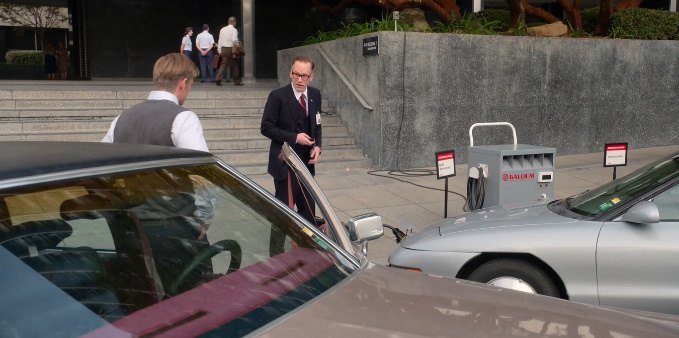
Mining operations on the moon lead to a surplus of lithium on Earth by the 1980s, spurring a clean energy revolution. By the early ’90s, electric cars are everywhere, fusion reactors power major cities. A fictional newspaper headline at the start of season three mentions that by the late 1980s, global warming has stopped. And in the mid ’90s, former astronaut Ellen Wilson comes out as gay while serving as America’s first female president. In 1996, she’s re-elected…with George H.W. Bush, her former secretary of state, as her running mate. Following her re-election, she signs a law legalizing gay marriage in the United States.
After an era defined by dystopia and hopelessness, it thrills me to see that hopeful, utopian stories are making a comeback in science fiction. Leave it to Ronald D. Moore, a writer who cut his teeth in the Star Trek franchise, to lead the way. For All Mankind is exactly what we all want right now: a glimpse of what our world could have been, and what it could be. Its clear message is that devoting ourselves to the peaceful exploration of the cosmos brings out the best in all of us.
As someone with a lifelong love and admiration for NASA, the early episodes of For All Mankind were hard to watch. I’ve told many friends that watching the Soviets beat us to the moon, then watching the Apollo 11 mission nearly end in disaster, was heart-wrenching for me. But I’m glad I pushed through it. Because by removing our nation’s single, greatest triumph, the writers of For All Mankind created a better world for everyone. It fulfills the promise of the show’s title, taken from the plaque left (in our reality) by the Apollo 11 crew, after they walked on the moon:
“Here men from the planet Earth first set foot upon the moon
July 1969, A.D.
We came in peace for all mankind”
All four current seasons of For All Mankind are currently available to stream on Apple TV+. A fifth season has not yet been officially announced, but is expected sometime in 2025. Writers have said their plan for the series currently spans seven seasons. Watch for next month’s “Sci-Fi Reviewed”, where I’ll be covering Paramount’s Star Trek: Discovery ahead of its final season.
 Michael T. Kuester