Like most Star Wars fans, I’ve always been fascinated by the Jedi. The fabled Guardians of Peace and Justice in the Galaxy, the Jedi Knights are arguably the most unique and iconic feature of Star Wars. And from the very beginning, they’ve been the cornerstone of the story: a representation of all that is pure and good.
In fairness, part of what made the Jedi so intriguing was how little fans knew about them. By the time period of the first film, the Jedi Knights were all but extinct. What little moviegoers knew of them came from the likes of Obi-Wan Kenobi and Yoda, among the few survivors. The prequel trilogy filled in some of the blanks, but those films were set during the twilight of the Jedi Order.
So for most of Star Wars, fans were kept largely in the dark. Many, like myself, wondered what the Galactic Republic looked like in its heyday, with thousands of Jedi Knights roaming the galaxy, performing good deeds and protecting the innocent. And for us, the Star Wars faithful, The Acolyte was one of the most exciting entries in the franchise’s history. At last, we’d get to see what a galaxy with a functioning (and non-authoritarian) government, aided by guardians of peace and justice, looked like.
Like many Star Wars fans, I was excited to see what this new era would hold. And like many, I was disappointed.
The Acolyte debuted with great expectations, promising a new story with the same flavor that made Star Wars an enduring classic. But in a misguided effort to reinvent the entire history of the franchise, the story went off the rails. The writers took some wild swings, attempting to turn bad into good and right into wrong. In doing so, they succeeded only in shocking and confusing their audience, and ultimately persuading them to tune out.
When I made my last “Sci-Fi Reviewed” post, I was looking forward to reviewing The Acolyte. I anticipated being able to hail it as a powerful entry into a new era of Star Wars television. Instead, this feels more like a post-mortem. So this month on “Sci-Fi Reviewed”, let’s take a look at The Acolyte: how it started, what they tried to do, and why it was never going to work.
The Premise
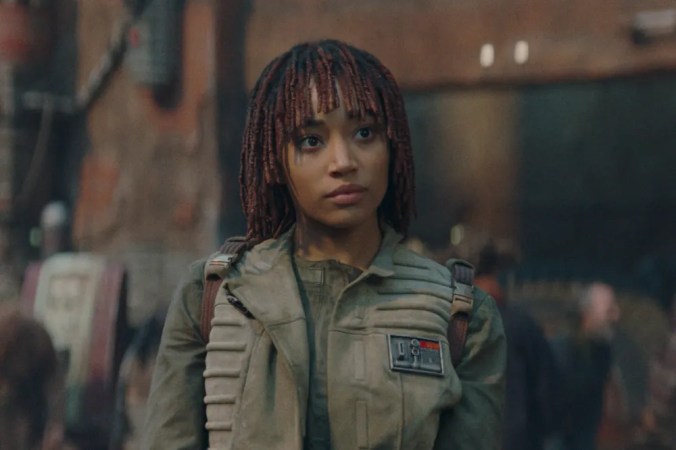
The Acolyte was the first Star Wars live-action property set during the “High Republic” era: a period originated by a conclave of writers several years ago. Taking place roughly a century prior to the events of The Phantom Menace, the era had already spawned successful series of novels and comic books, and a CGI animated children’s series.
The series revolves around Osha (played by Amandla Stenberg, who also portrays Osha’s twin sister Mae). A former Jedi padawan with a mysterious past, initially viewers know little about her, aside from her being rescued from disaster by the Jedi. Ultimately, Osha left the Order amid her inability to process the grief of losing her family.
At the outset, the series feels like exactly the sort of classic Star Wars story fans of the franchise (and space operas in general) were hoping for. The first two episodes gradually reveal what appears to be the overarching plot: Mae, believed to be dead, resurfaces while hunting down and murdering Jedi. The episodes introduce viewers to a great cast of characters: Sol, Osha’s former master who still feels a deep bond with her; Yord, a by-the-book Jedi Knight whose animosity toward Osha is clearly motivated by the pain of watching her leave the Order; and Jecki, Yord’s young apprentice, who’s unsure of herself but eager to stand out in the Order.
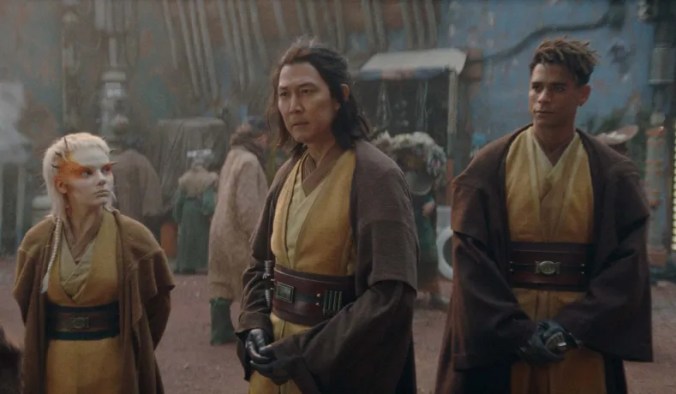
The formative episodes play out the way viewers would expect them to: the plot is introduced, Osha is explored (as is her relationship with Sol), and viewers are given the chance to bond with the characters. From the writing standpoint, at this juncture it’s clear the direction the series will take. Osha will join the Jedi characters to track down her sister, they will be given a tearful reunion. Osha will be taken under Sol’s wing again, she’ll reconcile with Yord, and she’ll become a mentor to Jecki. We see the early stages of these relationships, and everything points to a likely outcome: by the end of the first season, Osha will again be a Jedi Knight.
Then, the writers flipped the script on its head.
The third episode (which began the show’s ratings spiral) is entirely flashback. Many viewers hated this: an entire episode of backstory, doing nothing to further the plot. But I felt it worked; my only complaint was that it felt like an info-dump of backstory that I’d expected to be gradually revealed over the course of the season.
The fourth episode returns the story to the established main characters: Osha and her Jedi companions. By the end of the fourth episode, Mae’s dark master is finally revealed. By the end of the fifth episode, almost every character the viewers have been following has been murdered.
From there, the story grew increasingly uncomfortable. The Jedi are recast as villains, while the writers attempt to persuade viewers to embrace a villain who just murdered most of the main characters (including Jecki, a child). They try to paint Osha’s bonding with her Sith captor as her waking up to the truth, as opposed to trauma-induced Stockholm Syndrome. By the end of the season, it’s hard to see where the story was meant to go.
My Take

To be fair, the critical response to the series was largely positive. And to an extent, I get it. This was shocking. It was jarring. It was a very, very new and bold take on a long-established franchise. Many critics praised the show’s writers for daring to paint the heroes as villains and vice-versa. And, were this any other type of series, they’d have a point.
But while blurring the lines between good and evil may make for good television generally, this wasn’t general television. This was science fiction. It was soft science fiction. It was a space opera. And it was Star Wars.
I often say that one key to creating believable science fiction (or fiction in general) is remembering that in reality, there is no good and evil. Good people do bad things with the best of intentions. Bad people do bad things believing they have no other choice. But that works in hard sci-fi: science fiction that’s meant to be believable. Star Wars isn’t hard sci-fi. It has space wizards, mystical energies, beam swords that are completely impossible. This isn’t science; it’s fantasy. And in fantasy, there is good and evil. Hell, in fantasy, good and evil are crucial.
From the very beginning, at its heart, Star Wars has been a battle between good and evil. It’s long-established that, in Star Wars, the Dark Side corrupts. It stems from Jedi accessing the Force through negative emotions: fear, rage, hatred. Yet writers of The Acolyte sought to suggest that someone fueled by hatred can secretly be the good guy. And while it’s true that some who’ve turned to the dark side (like Anakin Skywalker and Ben Solo) have been redeemed, the very fact that they required redemption says all that needs to be said.
Even still, the writers might have succeeded, if they’d simply portrayed Mae’s Sith master as someone in hiding, content to practice his dark ways in solitude, wanting only for the Jedi to leave him alone. But they try to goad viewers into sympathizing with him less than a full episode after he’d sought out and murdered a group of Jedi, including a child. They show Osha seemingly intrigued by this mysterious murderer, apparently unbothered after watching him kill her friends. And by the final episode, they try to suggest Sol making a terrible mistake makes him completely irredeemable. Osha’s heartless murder of her former master is shown as being some twisted form of catharsis.
Much of the defense from the show’s ardent fans (and there are few) has echoed the defense of The Last Jedi: the previous most-polarizing Star Wars entry.
“Oh, you just didn’t like that it had LGBTQ themes.”
“So you just hate seeing people of color as the heroes.”
“I guess you’re just uncomfortable with a female protagonist.”
Like most viewers (I sincerely hope), I didn’t have any issue with any of that. Representation of minorities makes for good science fiction. Star Trek has spent half a century teaching a master class on it. But to me, this didn’t feel like a show meant to use representation to empower minorities. Like The Last Jedi, it felt like a show that hid behind them, hoping to pervert vital progressive ideals in order to hide the simple fact that it was bad.
And like The Last Jedi, it was bad. It was very bad. The Acolyte felt like every beginning writer’s worst ideas. “Well, what if the good guys are really the bad guys! What if I just unceremoniously kill off all the main characters! What if the ending offends everyone! Nobody’s ever done that before!”
That’s right. Nobody’s ever done that before. Because it doesn’t work. A second-act reveal is just good writing. A hidden plot is excellent writing. But introducing an intriguing group of characters, allowing your audience to bond with them, then slaughtering them just to prove a point, is not good writing. And trying to persuade your audience to cheer for a mass murderer only works if your audience is composed of sociopaths.
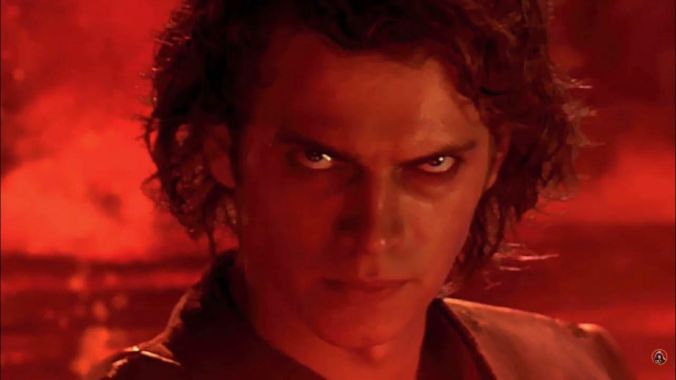
I try very hard to be supportive when I write my reviews. And I wanted very much to love The Acolyte. But I cannot remember the last time I felt truly traumatized by a television series. Through the second half of the season, I kept thinking about one of the iconic exchanges from Episode III:
OBI-WAN: Anakin, Chancellor Palpatine is evil!
ANAKIN: From my point of view, the Jedi are evil!
OBI-WAN: Well, then you are lost!
In Episode III, it was clear that Anakin was wrong. The Acolyte seemed to suggest that somehow, Anakin was right. – MK
 Michael T. Kuester