I can’t say it enough: I love Star Trek. I always have. So, like many longtime Trekkies, I was a little skeptical when Paramount announced they were developing an adult cartoon series set in the Star Trek universe. When I learned Mike McMahan, one of the creators of Rick and Morty, was creating it, that did little to convince me. Objectively, there are a lot of aspects of Star Trek that are funny. There have been more than a few comedic episodes of the various series (notably the infamous “Uh-oh” episodes of Deep Space Nine, which inevitably preceded a powerful, gut-wrenching episode). But the idea of a Trek series turning the entire franchise into a joke just felt wrong.
From the start, at the core of Star Trek there was a mission: to depict a brighter future. Since the original series, Star Trek has served as a powerful vehicle for social commentary. It has challenged viewers to ask themselves how the choices we make today might be judged by a more enlightened version of humanity. And it has strived to show a future all of us can believe in.
I hated the idea of a raunchy, tawdry cartoon, like Family Guy in space, making fart jokes and poking fun at Star Trek. Making Gene Roddenberry’s magnificent vision look cheap and silly. When the series premiered in 2020, I almost refused to watch it. But I did, because I love Star Trek.
Five seasons later, I owe Mike McMahan, Tawny Newsome, and everyone involved in Star Trek: Lower Decks an apology.
From the start, Lower Decks has been a delight. It has been hilarious and irreverent while still managing to be respectful. It’s optimistic and hopeful, as Star Trek should always be. And somehow, a show that set out to be Star Trek making fun of itself managed to truly capture the very essence of the franchise, in a way few other installments have.
Now, like many fans, I’m sorry to see Lower Decks go. So, as its final season passes the halfway mark, let’s take a look at Star Trek: Lower Decks: what made it funny, what made it special, and how an animated comedy somehow managed to give fans of ’90s Star Trek the happy ending we all wanted.
The Premise
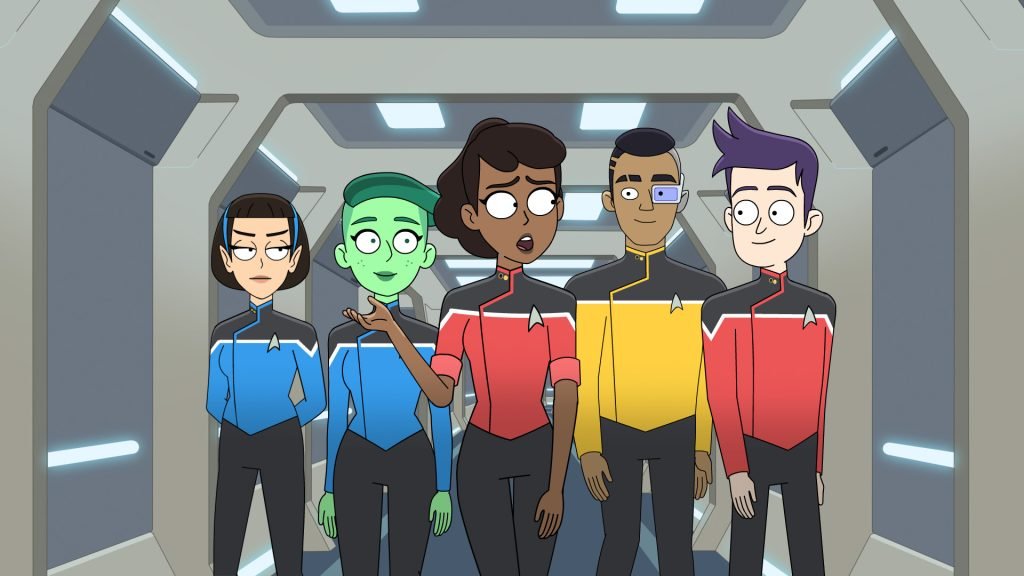
Star Trek: Lower Decks took its name from an episode of the final season of Star Trek: The Next Generation, which for the first time showed life aboard the Enterprise from the perspective of its junior officers. The premise of the series, as described by McMahan, was a show that followed the lowest-ranking officers doing the most menial tasks aboard the least-important ship in Starfleet. That ship ended up being the California-class U.S.S. Cerritos.
The show largely revolves around two command-division officers: timid and rank-obsessed Ensign Bradward Boimler (voiced by Jack Quaid) and chronically-insubordinate underachiever Ensign Beckett Mariner (voiced by Tawny Newsome). Joining them as major characters are junior medical officer Ensign D’Vana Tendi, an Orion, and hyper-capable engineer Ensign Samanthan Rutherford, a human with a cybernetic implant in his brain. Beginning at the end of season three, the four are joined by Vulcan science officer T’Lyn: a Vulcan who was banished from her post aboard a Vulcan science vessel for being “too emotional”.
The series frequently draws from established Star Trek tropes, from the crew dealing with alien artifacts that transform the ship to Starfleet’s tendency to run afoul of evil computers (several episodes show an entire warehouse in the Daystrom Institute, devoted to “Self-Aware Megalomaniacal Computer Storage”). An entire episode is devoted to a “cave mission”, a long-running Trek trope originally motivated by the ease of repurposing cave sets, and the expense of location filming. The characters make several nods and winks to the audience, noting the frequency of cave-ins and communications being blocked.
Throughout the series, the writers managed to pepper in existing Trek characters (all voiced by their original actors), from Will Riker (now captain of the Titan) to Kira Nerys, who is in command of Deep Space Nine. Even Q makes an appearance, voiced by the incomparable John de Lancie.
In keeping with what has become a long-standing convention, while the episodes are mostly stand-alone stories, each season features an over-arching plot, which comes to a head in the finale. While the first three seasons largely feature the main characters struggling with their mundane tasks as low-ranking officers, season four sees them promoted to lieutenant. From there, the stories shift to the characters’ struggles to grow into their new roles, as Mariner in particular is forced to face the underlying reason for her repeated demotions.
My Take
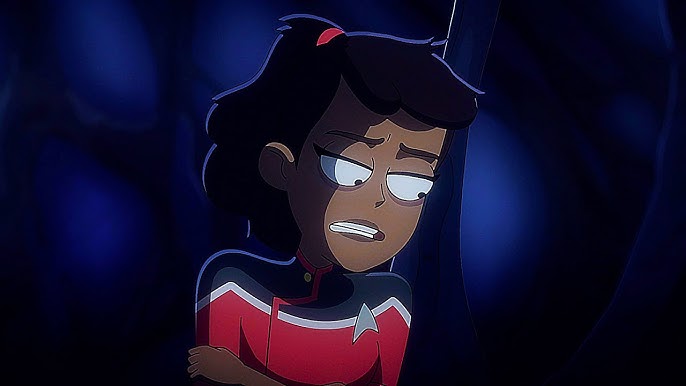
Look, Star Trek: Lower Decks was very funny. It was especially funny to longtime Trekkies like myself, who got all the inside jokes. And I could spend the next ten paragraphs or so detailing all the wonderful appearances of Trek characters, the heartfelt storylines, the happy endings. But there was a single scene in a single episode that I felt really defined the entire series.
Throughout the first three seasons of the series, Beckett Mariner’s chronic insubordination is a running gag. Viewers learn she’s been promoted and demoted numerous times, having served on numerous ships as well as Deep Space Nine. But in season four, after being promoted to lieutenant (again), she finds Commander Ransom (the ship’s first officer) is unwilling to demote her, no matter how hard she tries. Up to that point, Ransom had largely been shown as a stereotypical Riker-style macho man: a hyper-athletic, swaggering narcissist. But when Mariner challenges him to demote her, he informs her that he’d found a pattern in her Starfleet file: she was always trying to get demoted. For the first time, Ransom is shown to actually be a very competent officer: one who was able to see past her record of insubordination to the clear pattern beneath it.
Over the course of the season, Mariner grows increasingly self-destructive, culminating in a fight with a recurring Klingon character. After their fight, she finally admits why she’s always worked to remain an ensign: at the academy, she’d modeled herself after this “perfect friend”, Sito Jaxa.
When I heard that name, I recognized it immediately. Ensign Sito Jaxa was one of the main characters of the Star Trek: The Next Generation episode this series takes its name from. In that episode, Sito is serving aboard the Enterprise, desperate to prove herself after nearly being drummed out of the academy for her role a coverup after the death of a fellow cadet. Ultimately, Sito is tasked with a dangerous undercover mission, during which she is killed in the line of duty.
Suddenly, everything changed. Mariner went from being an irreverent renegade to a confused, traumatized young woman, still struggling to deal with the death of her friend. And somehow Sito’s character changed as well, as Trekkies realized that even after she was disgraced, at least one person never stopped looking up to her.
Lower Decks made a point of putting things right, and giving longtime fans closure the ’90s Trek series, and even the follow-up series Star Trek: Picard, never did. Sonya Gomez was a recurring character early in The Next Generation, depicted as a bumbling, rambling engineer and used mostly for comic relief. Lower Decks reintroduced her (voiced by the original actress), showing that she’d become one of Starfleet’s most well-regarded captains. Characters are frequently shown overcoming their flaws, from Ransom to Captain Freeman and the rest of the bridge crew. Over the course of the series, the bridge crew go from being depicted as self-important hacks on a backwater ship to being truly capable officers, despite their shortcomings. Characters who do wrong are given a second chance (including Badgey, a training program designed by Rutherford who turned homicidal, and Agimus, a megalomaniacal computer masterfully depicted by Star Trek veteran Jeffrey Combs).
And I can’t overlook the episode “Hear All, Trust Nothing”, in which Star Trek finally revisited Deep Space Nine. Early in the episode, Kira (now commanding the station, still portrayed by Nana Visitor), is shown gazing into the wormhole in silence. Though casual viewers might not have noticed, I’m sure my fellow Trekkies could see that she was looking for Ben Sisko, hoping for a sign that he was okay.
Through it all, Star Trek: Lower Decks managed to not only show how silly and bizarre life in Starfleet can be, but also why it all works. From Starbase 80 to the Cerritos itself, none of the Starfleet officers in the series are fazed by the mysterious artifacts, dangerous caves, or hostile alien species. They never throw up their hands and go home. Because in exploring the forgotten backwaters of the Federation, Lower Decks managed to prove something every Trekkie wanted to believe: top to bottom, every Starfleet officer believes in the mission.
Sure it gets weird, but as Kathryn Janeway said, “We’re Starfleet officers; weird is part of the job.”
So, Lower Decks, thanks for being weird. I loved every second of it. – MK
 Michael T. Kuester