While planning my next literary “Sci-Fi Reviewed”, I had a hard time deciding what book to go with. I’ve spent much of the past year gleefully immersed in modern sci-fi. I’ve read some good stuff, some great stuff, and some…other stuff. In the end, I decided to move right on to the next novel in the Expanse series: Caliban’s War.
The Plot
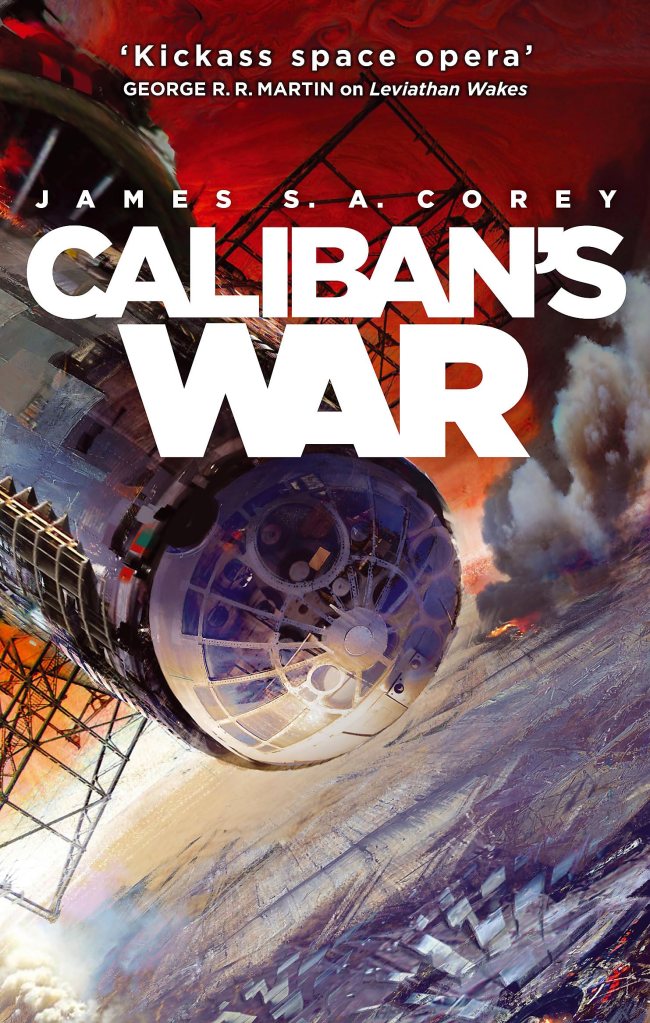
Caliban’s War takes place some time after the events of Leviathan Wakes. Since what is now dubbed the “Eros Incident”, James Holden the crew of the Rocinante have been working for Fred Johnson, a leader of the Belter quasi-state known as the Outer Planets Alliance. Most of their work involves fighting piracy as Johnson and other OPA leaders work to be viewed as the legitimate Belter government, rather than a terrorist organization.
The sinister corporate interests behind the protomolecule incident on Eros have continued their work, attempting to use the alien substance to produce human-based super soldiers. Their work is centered on Ganymede, which is primarily an agricultural world, dubbed the “Breadbasket of the Outer Planets”. In order to test their super soldier, the scientists behind “Project Caliban” unleash their creation on squads of UN and Martian marines. Conflicting reports from the engagement on the surface lead to a pitched battle between UN and Martian ships in orbit, resulting in the destruction of several of the moon’s solar focusing mirrors, which rains destruction on the fragile domes below.
As with all the installments of the series, Caliban’s War is a multi-POV story. This novel introduces a custom that persists until the fifth book, in which Holden is the only consistent POV character. Each novel introduces a new group of characters who tell the story. Caliban’s War is told from four perspectives: Holden’s, as well as Roberta “Bobby” Draper, a gunnery sergeant in the Martian Marine Corps; Chrisjen Avasarala, an undersecretary of the United Nations; and Praxidike “Prax” Meng, a botanist on Ganymede.
The story is once again told essentially from two directions. Bobby is the squad leader of the Martians who engage the super soldier on Ganymede. As the lone survivor, she finds herself a pawn in a dangerous game between the Martians, who want to keep their involvement in the project a secret, and the UN, which is aware of the protomolecule and trying to cover it up. After being drummed out of the corps, Bobby ends up being recruited by Avasarala, who is working to uncover the truth about Ganymede and its connection to Eros.
Holden and his crew join the relief effort on Ganymede, where they meet Prax. As the station falls apart, destroying his life’s work, Prax desperately searches for his daughter, Mei (who was an unwitting subject in the Project Caliban experiments). The crew agrees to help him search for Mei, and their search leads them to a firefight in the depths of Ganymede.
After escaping an assassination attempt at the hands of Jules Pierre Mao, the magnate behind the protomolecule experiments, Chrisjen and Bobby wind up on the Rocinante, leading to a fateful showdown on Io, after which the conspiracy is exposed and Prax is reunited with his daughter.
My Take
Since I first began writing, I’ve always written novels in multiple points of view. It just makes sense; I like to spread the story out, and it does a disservice to dismiss something happening somewhere else as unimportant. And one of the things that makes multi-POV so much fun to both write and read is the complexity. It allows a complicated story to be told from different perspectives, providing a richer picture.
Bobby is an excellent character, and I loved Chrisjen with her liberal use of profanity. But the character who really stuck out to me was Prax.
Prax stands out from all the other POV characters to this point for one simple reason: he’s just an ordinary person. He’s a hard-working botanist and a divorced single parent. He’s as devoted to his daughter as he is to his work. Through his eyes, the writers manage to capture something powerful: the way life in their future can seem ordinary. Prax works in a lab. He has an office, a desk. He cooks dinner. His daughter goes to school. While Chrisjen navigates the complex political currents of the Solar system’s most powerful government, Bobby is a trained marine, and Holden and his crew embrace life as outlaws in open space, Prax is focused on mundane activities of daily life. He dreads speaking with his ex. He worries about his daughter’s medical treatments. He works. He has an ordinary life.
And then, all hell breaks loose.
Through Prax’s eyes, the reader sees the inside of a disaster. With his station dying, riots as food shortages take hold in a land of plenty, people clamoring to leave before they run out of food or air, he latches on to the one thing he has left: finding his daughter. He’s willing to sacrifice everything just to see her again, and finds himself thrust into increasingly dangerous and terrible situations. Arguably the best scene in the entire book is one in which Prax experiences his first firefight. His sense of terror and disconnect, the way he describes such sudden and terrible violence, stands out, and for a moment a story that hinges on intrigue and adventure is suddenly, painfully human.
For most sci-fi writers, your first attempts at writing involve powerful people. Leaders and heroes, rushing bravely into the jaws of danger. But if you’re smart, you move away from that pretty quick. Because the truth is, nobody wants to read about an epic hero or heroine who’s ready for everything, burdened by the glorious purpose of leadership. The way I like to put it, great literature isn’t about people who make things happen; it’s about people who have things happen to them.
Prax was an incredible character because he was relatable. His inclusion allowed the reader to put themselves in the shoes of someone they could understand. Not a powerful politician, or a battle-hardened soldier, or the self-appointed savior of the universe. Just a guy who’s lost everything, and will sacrifice whatever he has left to get just one small part of it back. That’s the good stuff. – MK
 Michael T. Kuester