Interstellar travel is inevitable. One day, maybe sooner, maybe later, we will leave our solar system behind. Think about it: one billion other stars in our galaxy alone, many with their own system of worlds, more alien and incredible than our feeble imaginations can fathom.
So, when the time comes, where will we go?
The arrangement of stars in space is something few average people understand. Looking up at the night sky unaided, gauging distances between them is nigh impossible. And the reality of interstellar distances is something seldom touched upon in science fiction. So, in this “Science in Fiction”, let’s take a look at our interstellar neighborhood, and see where humanity might go when we take our first steps into the greater galaxy.
Stellar Positions in Science Fiction
Travel between star systems is commonplace in science fiction. Far less common is any mention of exactly where these star systems are located. There’s a simple, practical reason for this: it’s hard. Some sci-fi properties hinging on interstellar travel, like Star Wars, manage to side-step the issue by being set in different galaxies. George Lucas never even bothered to indicate exactly which galaxy his Galaxy Far, Far Away was (though some have speculated Star Wars may be set in the Triangulum Galaxy).
Star Trek, the best-known example of hard sci-fi, had taken a stab at it here and there. Alien species in the various series are mentioned hailing from Capella, Altair, Aldebaran, and Deneb, among others, along with periodic references to human colonies on planets orbiting Alpha Centauri and Vega. Perhaps their best-known direct reference was to Wolf 359: a nearby red dwarf, where Starfleet battled the Borg in the Next Generation episode “Best of Both Worlds”.
Of course, for various reasons, Star Trek has never given any real indication where major planets in the story are located. Though it’s worth noting that Gene Roddenberry suggested the planet Vulcan orbited the star 40 Eridani A: a K-dwarf roughly sixteen light years from Earth.
Stellar Positions in Science
It’s not even worth mentioning that space is vast, and the distances between stars are nearly unfathomable. But our focus here is on where the stars are. And the first thing to remember is the simple fact that space is three-dimensional.
It may sound obvious, but take a moment and picture a map of space in your mind. You’re probably imagining one of the star charts readily available to amateur astronomers. And this illustrates the core fallacy of our reckoning of space: our limited perspective, viewing the heavens from our place here on Earth.
And when I first began planning the series of novels that begins with Pioneers, this was the first place where I went wrong.
While trying to decide where to place fictional human exocolonies, I set out looking for a map of local space. And I found this:
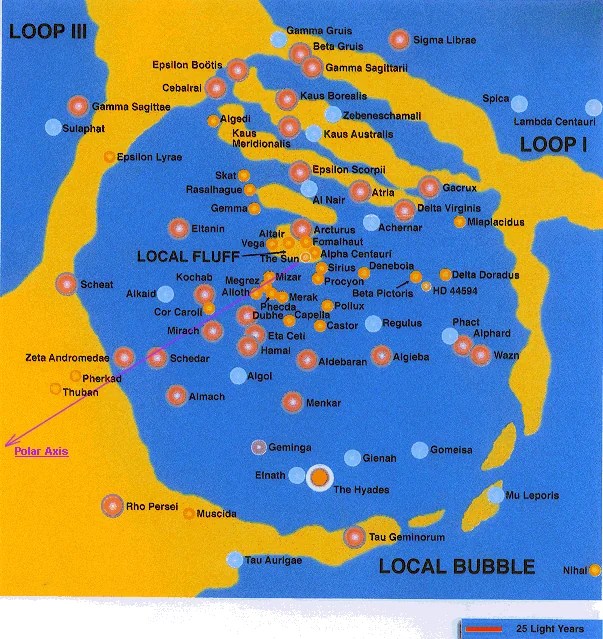
Just look at all those stars, so close to us! Heck, Fomalhaut is right next door! So many possibilities, and with a warp-capable starship we could be there in no time!
It didn’t take long (though longer than it should have), before I began running into problems. It started when I began looking at distances between Earth and the stars on the map above. After some well-deserved forehead-slapping, I went back out there, and found more useful, accurate maps of local stars, like this one:
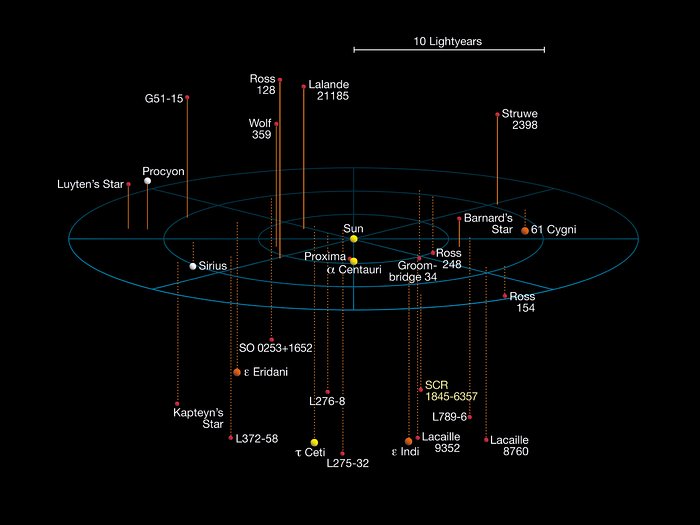
And there’s the problem. Hawkeyed readers may notice that Fomalhaut is completely absent from this map. That’s because, despite appearing tantalizingly close in my original map, Fomalhaut lies roughly twenty-five light years from Earth. That puts it at roughly the same distance as Vega, much further away than Sirius’s comparatively modest nine light years. Sirius, it’s worth noting, is among the few nearby stars whose distance can be reasonably inferred from a two-dimensional map, as it lies nearly coplanar with our solar system.
Viewing space in two dimensions is the first, easiest mistake, and a forgivable one given our limited perspective of the universe. The second concerns distances. And there, the most important thing to remember is this: honestly, we don’t actually know exactly how close most stars are to Earth.
On Earth, it’s easy to calculate distance. But when peering into space, it’s far more difficult. To do so, astronomers rely on parallax measurements: a trigonometric function that uses a star’s apparent movements with respect to background stars to determine its distance from Earth.
This function, mind you, does not provide an exact number, rather it yields an estimate. For instance, current parallax measurements place Fomalhaut at a distance of 25.793 plus or minus .005 light years from Earth. That margin of error might seem fairly small, but bear in mind that .005 light years translates to just over 47 billion kilometers.
And, of course, when writing science fiction about a thriving interstellar civilization, the distances between other stars and Earth aren’t all that matters; the distances between those other stars matter as well. This is where triangulation comes into play: if one knows the apparent magnitude, distance from Earth, and location in our night sky of two stars, determining the distance between the two is simple. Though again, our distance measurements are estimates, and an estimate of an estimate should be taken with a 47 billion kilometer grain of salt.
So, what does all this mean for the modern hard sci-fi writer looking to use existing stars as their setting? Well, modern astronomy can provide a lot of answers, but it takes a great deal of research. Over the years, I’ve read numerous actual scientific research papers to fact-check my work. Not everyone needs to dive that far in, but always remember that space is three-dimensional, and that all our measurements of stellar distances are estimates. It can help to be vague; after all, future humans for whom interstellar travel is routine aren’t likely to go around casually discussing the exact distances between stars. When was the last time you told someone you drove 12.371 miles to go somewhere?
One day, we’ll have more precise measurements of the distances between stars, but it may take actually going there for us to know for certain. Until then, the space between stars is left to astronomers, and writers of science fiction. – MK
 Michael T. Kuester