This week, I’d originally planned to get back to film and television with my “Sci-Fi Reviewed” posts. But with all the writing I’ve been doing lately, it just didn’t feel right. So instead, I’m forging ahead with the third novel in James S.A. Corey’s Expanse series: Abaddon’s Gate.
The Plot
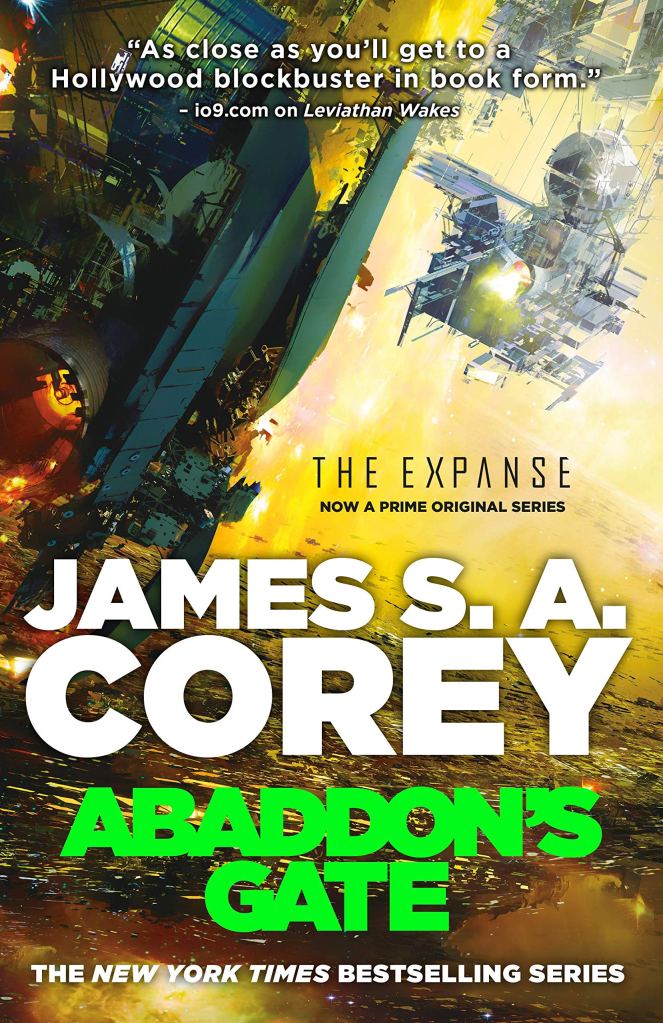
Following the events of Caliban’s War, the mysterious alien substance known as the “Protomolecule” has revealed its purpose: it has used Eros, all its inhabitants, the surface of Venus, and the bodies of Joe Miller and Julie Mao, to build something: an enormous ring, parked beyond the orbit of Uranus. At first its purpose is a mystery, until a thrill-seeking “slingshotter” attempts to guide his ship through the ring. In violation of all known laws of physics, the ring abruptly stops his ship. The sudden deceleration kills him instantly.
After the slingshotter fails to emerge from the other side, it is determined that the ring is in fact the mouth of a wormhole. The governments of Earth and Mars swiftly put aside their differences to mount a joint expedition to the space beyond the ring, including teams of scientists and even dignitaries including theologians, artists, and poets. The Outer Planets Alliance, eager to legitimize itself as the unified government of the Belt, sends the Naavou, a repurposed generation ship capable of generating spin gravity. After the Martian government sues to reclaim their lost battleship, the crew of the Rocinante reluctantly agree to ferry a team of reporters from Earth through the ring.
As with all the installments of the series, Caliban’s War is a multi-POV story. This novel continues a custom that persists until the fifth book, in which Holden is the only consistent POV character. Each novel introduces a new group of characters who tell the story. Abaddon’s Gate is told from four perspectives: Holden’s, as well as Reverend Anna Valovodov, a Russian Methodist pastor; Bull, a longtime associate of OPA leader Fred Johnson who’s assigned to the Naovoo (rechristened OPA Behemoth); and Clarissa Mao, daughter of disgraced protomolecule mastermind Jules Pierre Mao, who sneaks aboard a maintenance ship posing as “Melba Koh”, intent on murdering Holden for exposing her father.
Unlike the previous novels, Abaddon’s Gate doesn’t follow separate stories in different places; all the characters are aboard ships entering the ring. After Clarissa rigs an explosion aboard a UN ship and implicates Holden, the Rocinante evades destruction by the combined fleet by speeding into the ring. Within, they find a single, spherical station in what appears to be a blank void. When torpedoes launched at the ship are stopped by the station, Holden and his crew determine that the station has imposed a “Speed Limit” within the ring space.
As the other ships enter what Holden dubs the “Slow Zone”, Holden is guided by a vision of the late Joe Miller to board the station. There, he learns that the protomolecule’s builders once controlled a vast civilization, spanning thousands of star systems linked by gates, with the Slow Zone serving as a hub. He also learns that their civilization is long gone, wiped out of existence by some unknown enemy even more advanced than they were. Holden quickly realizes everyone in the Slow Zone is in danger, but before he can warn anyone he’s confronted by a group of Martian marines. In the ensuing showdown, one of them launches a grenade.
The station easily repairs the damage, then moves to defend itself. After killing the marine, it abruptly lowers the speed limit. Across the combined fleet, hundreds are killed by the sudden deceleration, many more seemingly doomed due to internal injuries that cannot heal without gravity. Bull, aboard the Behemoth, is nearly crushed, and is forced to move about the ship with a modified mech after being paralyzed from the waist down. Aboard the UN flagship Agatha King, Anna is overwhelmed by scenes of death and destruction, and pitches in as a nurse.
Amid the calamity, Clarissa seizes the opportunity to leave the ship in a spacesuit and board the Rocinante, intent on killing Holden and his entire crew, unaware that Holden himself is no longer aboard. After nearly killing Naomi, she is subdued by Anna, who followed her. Soon after, the captain of the Behemoth invites the crews of all other ships to send their wounded to his ship, which is capable of spinning to simulate gravity. There, as Holden is reunited with his injured crew and Clarissa contemplates her failure, the surviving leaders of the fleet plan their next move. Ultimately, they determine that the ring poses an imminent threat to the people of their solar system. They cannot escape, so their only option is to destroy the gate, which they hope to do by repurposing the Behemoth‘s powerful communications laser.
Having seen that the station can destroy entire star systems if it is threatened, Holden pleads with them to reconsider. He suggests instead that the station is reacting to them as a threat, and in order to show that they are not, all ships must shut down their fusion reactors. In desperation, Holden leads a team to assault the ship’s command center, while Anna pleads with the crews of the other ships to shut down their reactors. Even as firefights rage across the Behemoth, one by one the other ships power down. And after being unexpectedly saved by Clarissa, Holden manages to power down the Behemoth.
Soon after, the station releases its grip on all the ships, lifting the speed limit. As the crews watch, over a thousand additional gates open around the Slow Zone, each leading to a different star system.
My Take
As with Caliban’s War, I entered this book with a decent understanding of the story. And as with Caliban’s War, I was surprised by the character I gravitated to:
This time, it was the Methodist minister, Anna Volovodov. Pastor Anna.
The Expanse is by no means a feel-good series of novels. It’s grim and ugly, and not afraid to get really dark. But this one was particularly unafraid of the darkness. After largely dealing with class warfare and colonialism in a futuristic setting for the first two novels, Abaddon’s Gate hinges on big, terrifying questions about alien life and our position in the universe. And Anna Volovodov plays the same part in it that Prax played in the previous novel: a human window into the wholly inhuman.
Besides James Holden, Anna is probably the only other truly good person in the series. She is gentle and kind, attentive, always worried she’s not doing enough good. Always questioning whether her motives are selfish. She puts her fear aside when humanity is at its worst.
From Clarissa’s descent into murder and deceit to the mutinies (yes, more than one) aboard the Behemoth, to the very nature of the ring gates and the extremely advanced (and callous) beings who built them, and the mysterious enemy that eradicated them, this may be the most unsettling book in the entire series. But Anna helps the reader to make sense of it.
And through her, the writers ask some potent questions about just how humanity would react in the face of an alien intelligence. Many of the characters are shown simply reacting to each new development. They never stop and question, driven by their own fear of self-interest. Only Anna, and Holden, are willing to stop and ask if we could ever truly understand the motivations of an intelligence completely unlike our own.
Today, for many it’s increasingly difficult to separate religion, especially Christianity, from its worst elements. Probably because right now those worst elements tend to be the loudest. In Abaddon’s Gate, Father Cortez, a character depicted as a 23rd century televangelist, serves as the stand-in for them. He’s long-winded and self-important, spouting off about the strength of his faith yet swiftly giving in to fear.
But Anna is a reminder that beneath all the Joel Osteens of the world, there are still people who, rather than thumping their bibles, would rather read them. And though I may not be religious myself, now more than ever I’m glad to know there are real Pastor Annas out there. – MK
 Michael T. Kuester
This is the novel in the series where things really began to take off, and the universe was suddenly both more immense and more accessible.
LikeLike
I like to think of Abaddon’s Gate and Cibola Burn as a sort of combined “climax” of the series. Everything changes from there on.
LikeLiked by 1 person