When it came to sci-fi in the ’90s, Star Trek was king. After taking some time to find its footing, Star Trek: The Next Generation had succeeded in totally reinventing the franchise. Its success had vaulted Star Trek from camp into mainstream popularity, spawning countless imitators that produced a sort of mini-renaissance of science fiction television. But by 1993 TNG was nearing its conclusion. That left Rick Berman, Gene Roddenberry’s successor as Trek’s showrunner, and his writers with the unenviable task of producing a successor to what had become the first blockbuster sci-fi hit on the small screen.
One of the hardest things for a writer to do is move on from a wildly successful project and do something different. Expectations are high. Another show about Starfleet’s best of the best on an intrepid mission of exploration would feel derivative. The key, they realized, was to find something totally different, while remaining true at its heart to Star Trek‘s core values.
The result was Star Trek: Deep Space Nine.
To call it a stark departure from everything that came before would be a gross understatement. It took place on a space station, not a ship traveling through space. It featured Star Trek‘s first African American lead (and second captain, after the captain of the U.S.S. Saratoga in Star Trek IV), and the first Trek captain who was also a parent (an active parent, as opposed to James “Oh, turns out I have a son” Kirk). And it took Star Trek where it had truly never been before: the seedy outskirts of the franchise universe, where the Federation’s values were tested on a weekly basis.
Like its predecessors, Deep Space Nine took some time to find its footing, and even longer to step out of the long shadow of The Next Generation. But by 1995, Deep Space Nine stood alone, carrying the banner of Star Trek toward the 21st century. And its darker, more emotional, character-driven storytelling set the tone for sci-fi in the new millennium. So this month, on the heels of DS9‘s 33rd anniversary, let’s take a look back at what made it fresh, what made it special, and what makes Deep Space Nine withstand the test of time.
The Premise

Star Trek: Deep Space Nine broke new ground for the franchise in many ways. Nearly all of the show’s seven seasons takes place entirely on the eponymous Deep Space Nine: a run-down space station originally built by the Cardassians in orbit of the planet Bajor. The series begins with Commander Benjamin Sisko (played masterfully by Avery Brooks) arriving at what is considered a backwater post on the frontier of Federation space.
Sisko’s task from the outset is a tall one: to help the Bajoran people rebuild after generations of brutal rule under the Cardassians, in hopes of grooming them for Federation membership. The station is falling apart and the Bajorans themselves are divided, with some seeing Federation assistance as trading one oppressor for another. Sisko himself isn’t sure he wants the job; he’s still haunted by the death of his wife at the hands of the Borg, and quickly decides Deep Space Nine is no place to be raising his son, Jake.
But when he discovers a stable wormhole constructed by seemingly omnipotent aliens within the Bajoran star system, everything changes. Overnight the station (which is moved to the mouth of the wormhole) shifts from being a dead-end post to arguably the most important installation in the Federation, allowing it sole control over access to the distant Gamma Quadrant.
Sisko’s initial crew includes Miles O’Brien, a transplant from The Next Generation; overly-enthusiastic doctor Julian Bashir; science officer Jadzia Dax, who carries a symbiotic lifeform that provides access to all its previous hosts’ memories; and Kira Nerys, his Bajoran first officer, who initially finds it difficult to accept the authority of a human in orbit of her home planet.
Over the course of the series, the show manages to produce intriguing storylines despite remaining firmly rooted in one location. Though there’s plenty of classic Star Trek space mystery (especially during the first few seasons), over time the series writers learned to lean on the interpersonal relationships between the characters, turning DS9 into Trek‘s first true character-driven series. As the seasons progress, contact with the malevolent Dominion in the Gamma Quadrant comes to dominate the overarching plot, leading to the series becoming an increasingly-serialized war epic, presaging the format of modern sci-fi series.
The Response
Though many critics praised the show’s originality at the onset, during its run Deep Space Nine never enjoyed the same level of success as its direct predecessor (The Next Generation) or successor (Star Trek: Voyager), with some modern critics suggesting Paramount’s focus on those two shows was partly responsible for DS9 being held back. Over the show’s run the critical response soured, to the point where by its final season, some critics used it as shorthand for poor acting and dialogue.
But the show received its share of recognition: it garnered 31 Emmy nominations (winning five) and was nominated for two Hugo awards. Throughout its run, the series received consistent praise from African American and Latino viewers for its positive handling of minority characters. The Sisko family, in particular, was singled out for what was unfortunately a rare depiction of a healthy male African American family unit. And in the years since the show ended, its reputation has been restored as critics have revisited its groundbreaking storytelling.
My Take
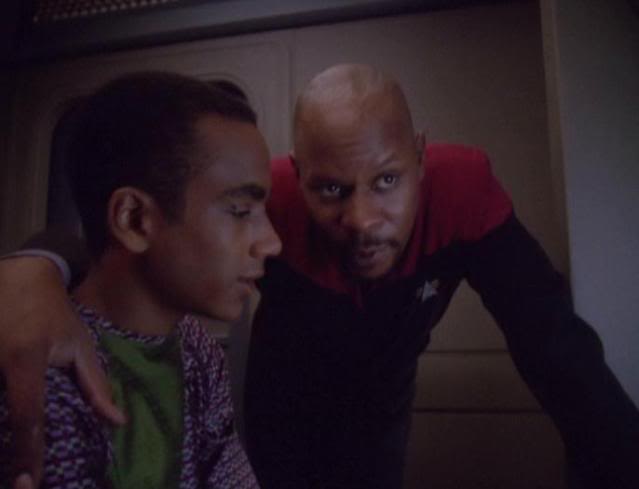
As I mentioned earlier, over time Deep Space Nine‘s writers realized they couldn’t embrace the “mystery of the week” model prior Trek series had relied on. Being stuck on a space station, they gradually shifted the focus from space adventure to the relationships between the characters, at times giving the series more of the atmosphere of a soap opera (or even a situational comedy). And in so doing, they created something prior Trek installments had sorely lacked: healthy relationships.
Prior Trek series had often featured romance (albeit fleeting), and enduring friendships (Kirk and Spock, Geordi and Data). But Deep Space Nine outdid them all. The slow-blooming friendship between Miles O’Brien and Julian Bashir is arguably the most realistic, healthy male friendship in all of Star Trek. The tension between O’Brien and his wife, Keiko, in the early seasons gives way to showing how couples triumph over adversity and make things work. Sisko’s relationship with Jadzia Dax (and her successor as host of the Dax symbiont, Ezri) stands as a lasting example of healthy platonic friendship between a man and a woman. After butting heads frequently in the early seasons, Sisko and Kira develop a working relationship based on mutual trust and respect. His son Jake’s friendship with Nog, a Ferengi boy, helps (along with Armin Shimmerman’s portrayal of Nog’s uncle, Quark) to transform the Ferengi from kleptocratic bad guys into lovable schemers.
But arguably the most valuable relationship Deep Space Nine gave us was that of Ben Sisko and his son. Star Trek‘s history had been littered with terrible parents, from Kirk to Beverly Crusher to perhaps the worst example, Worf. But from the outset, DS9 casts Ben Sisko as a great dad: eager to do right by his son, striving to set a good example, always afraid he’s doing it wrong. And particularly in the early seasons when he’s still a child, Jake consistently displays the best aspects of humanity, learned by following his father’s sterling example. The fact that the first good parent in all of Star Trek was an African American widower made Deep Space Nine about as Star Trek as Star Trek can get.
Deep Space Nine was the first Trek series to show the cracks in Gene Roddenberry’s utopian vision of humanity’s future. Characters are messy, they fight and feud, they make mistakes. But all of that served to make the series a very personal, very intimate, very human show. And in the end, it did something Gene Roddenberry had never been willing or able to do: it made Star Trek relatable. – MK
All seven seasons of Star Trek: Deep Space Nine are currently available for viewing on Paramount+.
 Michael T. Kuester