Stop me if you’ve heard this one:
A human commander is assigned to a space station, primarily to keep the peace between a powerful alien species and the species they’d previously enslaved. The station is initially a backwater post, but quickly becomes the most important bulwark against an alien threat from the furthest reaches of our galaxy. And the station’s commander slowly realizes his true destiny as the messiah of an ancient alien race.
If you’re thinking, “Hey, that’s Star Trek: Deep Space Nine“, you’re right. And wrong, because that’s also the premise of the ’90s television series Babylon 5.
Premiering contemporaneously with the better-known (and received) Deep Space Nine, Babylon 5 never approached the mainstream success of its counterpart, due largely to its lack of association with a popular franchise (or the resources afforded by a major studio). But it was a visionary series, introducing many of the key features of modern sci-fi television decades before they became the norm. So this month in “Sci-Fi Reviewed”, let’s take a closer look at Babylon 5: what made it special, what made it work, and how its creators used a shoestring budget to reinvent science fiction.
The Premise

Babylon 5 follows the human crew of the eponymous space station: a Bernal cylinder built as neutral ground following a series of interstellar wars. Among the ways the series blazed new ground was its treatment of humanity: humans are shown as being somewhat less-advanced, both culturally and technologically, than many of their counterparts. Notably, they’re at a distinct disadvantage against the mysterious Mimbari, who had previously fought a costly war against the human race over a simple miscommunication.
Arguably the biggest innovation of the series was its heavily-serialized storytelling. In an era when television series were largely episodic, the creators of Babylon 5 had a clear plan for an interconnected story arc spanning five seasons. Each episode advances both the character development and the overarching plot, which ultimately focuses on the return of the Shadows: an ancient, malevolent alien race. The main character of the series, Jeffrey Sinclair, was largely written out after the first season (due to actor Michael O’Hare’s real-world struggle with schizophrenia), replaced starting in season two with Captain John Sheridan as the new station commander.
While Deep Space Nine managed to wiggle a bit within the confines of Gene Roddenberry’s utopian vision of the future, Babylon 5 had no such constraints. Showrunners were free to explore the darker elements of humanity, from greed and lust for power to more personal struggles like drug and alcohol addiction. The characters are flawed and relatable; they make mistakes, fail in relationships and their jobs, betray and forgive one another.
The storytelling fit with the other major innovation of the series: its status as perhaps the first true example of hard sci-fi in television. Spacecraft are shown obeying the laws of physics to the letter: in combat they make use of momentum in space, moving in three dimensions in a manner more believable than Star Trek‘s rigid, battleship-like formations. And humans are acknowledged as being unable to produce true artificial gravity. Most human spacecraft are shown to have sections that spin to simulate gravity, with some ships shown to be a fully microgravity environment.
All of this was made possible in part by the show’s groundbreaking use of CGI. While the creators of Star Trek still made extensive use of physical models, budget constraints forced Babylon 5 to eschew expensive models in favor of computer graphics. As a result, the show’s artists were better-equipped to faithfully depict space travel.
The Response
Despite its significant disadvantages against the juggernaut Star Trek series airing alongside it, Babylon 5 managed to make some noise. The series garnered nine Emmy nominations (winning two). It was widely-praised in science fiction circles, winning two Hugo Awards, A Nebula Award, and the Saturn Award for Best Syndicated/Cable Television Series in 1998, for its final season.
Though it flew under the radar through most of its run, in recent years the series has been lauded for its indelible influence on science fiction storytelling, with TV Guide ranking it the thirteenth-best cult TV series ever in 2007. The show’s serialized storytelling led directly to the modern model for sci-fi television, with Ronald D. Moore (who worked on Deep Space Nine) having used it as a blueprint for both the later seasons of DS9 and his later remake of Battlestar Galactica.
My Take
So before anyone can discuss Babylon 5, they must acknowledge the Cardassian-built elephant orbiting Bajor. Throughout its run, Babylon 5 was frequently criticized for its similarities to Star Trek: Deep Space Nine, to the point where it was frequently labeled as derivative. And in fact, there was a relationship between the two. But critics at the time had it backwards.
The creators of Babylon 5 had approached Paramount Studios as early as 1989 to pitch the series, providing the studio with their series bible (basically the premise of the show) as well as a sampling of episodes taken from all five seasons. Paramount passed on the series, but later announced Deep Space Nine. In the years since, it’s been revealed that while Rick Berman (and Ronald D. Moore) never actually viewed the pitch for Babylon 5, the studio secretly used it to guide development of Deep Space Nine. In the cruelest of ironies, the showrunners of Babylon 5 had to watch as their original work was labeled as a cheap knock-off. It was revealed in 2017 that the showrunners did bring a plagiarism lawsuit against Paramount, which was quietly settled out-of-court for an undisclosed sum.
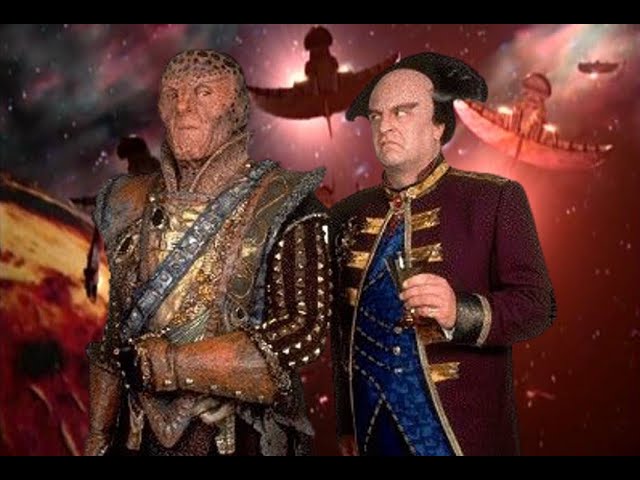
But the truth is, Babylon 5 only resembles Deep Space Nine if you squint really, really hard. The show’s clear plan from day one helped writers produce some of the most distinctive, and loveable (and, at times, hateable) characters in all of science fiction, from the irascible Londo Mollinari to the sometimes-sympathetic, sometimes antagonistic G’Kar. The series featured layered plots and characters that shifted and changed as the show progressed. And it explored the darkest corners, and brightest points, of humanity in a way Star Trek never could.
All five seasons of Babylon 5 are currently available for viewing on Roku TV.
 Michael T. Kuester