By the early 2000s, it looked like Star Trek was played out. They’d had a good run, with three successful series and a string of blockbuster films. But in 2001 Star Trek: Voyager was wrapping up, and the cast of The Next Generation was aging out of cinematic relevance. For the first time since the mid-1980s, Star Trek faced an uncertain future. Rick Berman, Gene Roddenberry’s successor as creative head of the franchise, was charged with determining the direction of Star Trek going forward. In the end, his decision was to go backward.
From its inception as Star Trek‘s first prequel, Enterprise did everything it could to distance itself from its successful predecessors. It was rough and edgy. Its human characters were hot-headed, impulsive, and wore blue jeans. Its title sequence featured vocal music. Even its name, Enterprise, was the first title not to feature the words Star Trek. At least for the first few seasons. And in the end, trying so hard to not be Star Trek may have been the problem.
It could be said that the deck was stacked against Enterprise from the start. The series came along in a period that could be considered a “dead zone” for science fiction. It debuted on the heels of several prominent sci-fi series ending their long runs, at a time when television viewers were suffering from “Star Trek fatigue”. Regardless, in the end Enterprise became the first Trek series since the first to be cancelled prematurely, leaving fans to wonder what might have been.
As the Star Trek franchise stands poised once again for a transition to an uncertain future, this month let’s take a look at Star Trek: Enterprise; what it tried to do, where it failed, and how showrunners figured things out too little, too late.
The Premise
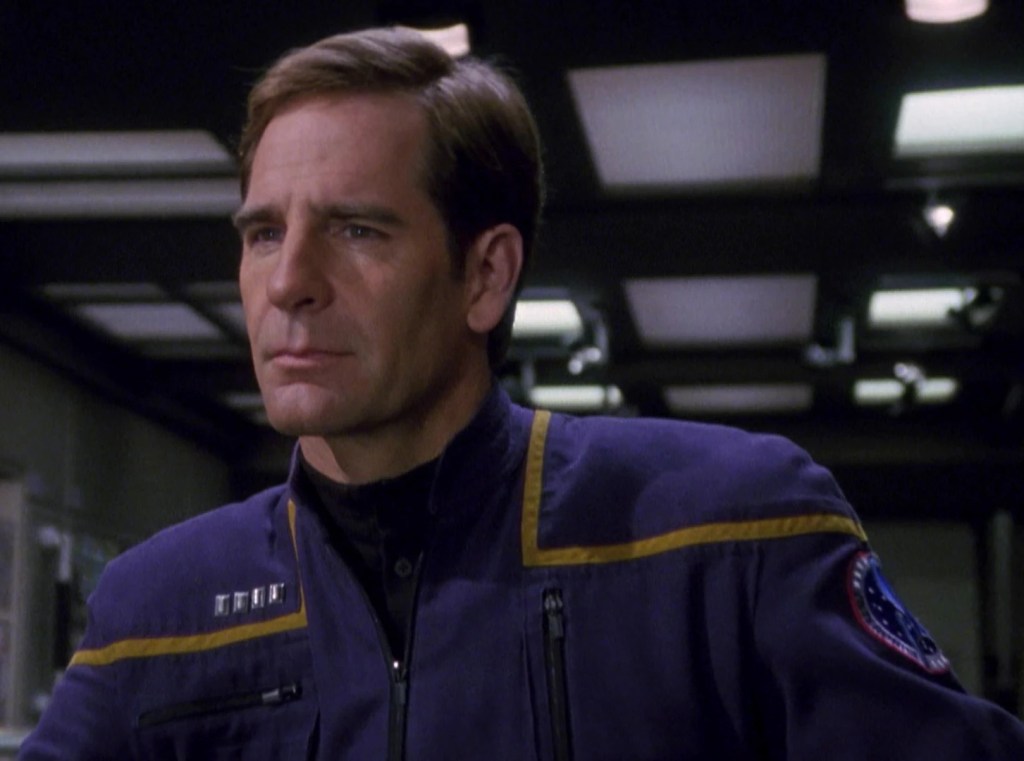
Star Trek: Enterprise was only the second Trek series developed following the death of franchise creator Gene Roddenberry, and was the first to violate one of Roddenberry’s core tenets for Trek: that the series should always be moving forward in its established timeline. Rick Berman and his writers believed that after three television series and as many feature films, the franchise’s 24th century storylines were played out. Ultimately, it was decided the next series would serve as a prequel to all previous installments.
Thus, Enterprise was set in the mid-22nd century: over one hundred years prior to the events of the original series. From the start, the series set about rewriting or solidifying long-standing elements of Trek lore. It established that humanity had made only marginal advancements in space travel over nearly a century since Zephram Cochrane’s first warp flight, and that the ubiquitous Starfleet actually predated the Federation.
The series revolves around the crew of the NX-01 Enterprise (predating the “U.S.S.” designation of later Federation ships). As humanity has had only limited contact with other intelligent species by this point, the crew is almost entirely human. From the start, showrunners wanted to depict a more relatable version of humanity. Several characters had accents that were largely prohibited on prior series (to depict a fully homogenized mankind). They wore blue jeans and t-shirts when off duty. And, perhaps more importantly, they were more flawed, prone to leaps in judgement and risks.
Another first came in the series casting: for the first time, the main cast was headlined by an established actor. Jonathan Archer, warp engineer and captain of the NX-01, was played by Scott Bakula, best known for his leading role in the televisions series Quantum Leap. And to be fair, Bakula did what all great Trek captains do: set the tone for the series and steal the show.
Archer was the generally the quintessential Trek captain: bold, inquisitive, fearless, and compassionate. But his crew was far more relatable than the intrepid explorers of prior series. His engineer, Charles “Trip” Tucker III, was a Floridian with a thick drawl, quick to judge alien species from the perspective of human morality. Amory officer Malcolm Reed was a dour Englishman, and the first member of his family not to join the Royal Navy (which was thus established to still exist in the 22nd century). His communications officer, Hoshi Sato, was responsible for developing and refining the universal translator (one of Trek‘s oldest McGuffins) despite being prone to space sickness and largely terrified of alien danger.
Of course, one of the longest-running and best Trek tropes is the “outsider character”: a non-human member of the crew who provides a chance to explore humanity. Though there were two alien crewmembers, it was Denobulan doctor Flox who largely provided the outsider capacity. The other character, Vulcan first officer T’Pol, originally served as a foil to Archer and his crew. This was largely due to the Vulcans being cast as semi-antagonistic in the early seasons, with many humans (including Archer) accusing them of intentionally slowing the progress of human technology.
The Response
Over the course of its run, Enterprise was nominated for seventeen Emmys, winning four. It also drew six Saturn Award nominations, though its only two wins came during its first season. Though the series premiere “Broken Bow” was lauded by critics, the reviews grew increasingly mixed as the series progressed. By the second season reviews had gone from mixed to hostile, with critics calling the show “broken”, citing among other things its continued reliance on episodic storytelling (which by that point was already going out of fashion).
The third season’s story arc, showing Archer and his crew on a desperate mission of revenge against the alien Xindi, further polarized critics. Ultimately, the show was cancelled prior to the premier of its fourth and final season.
My Take
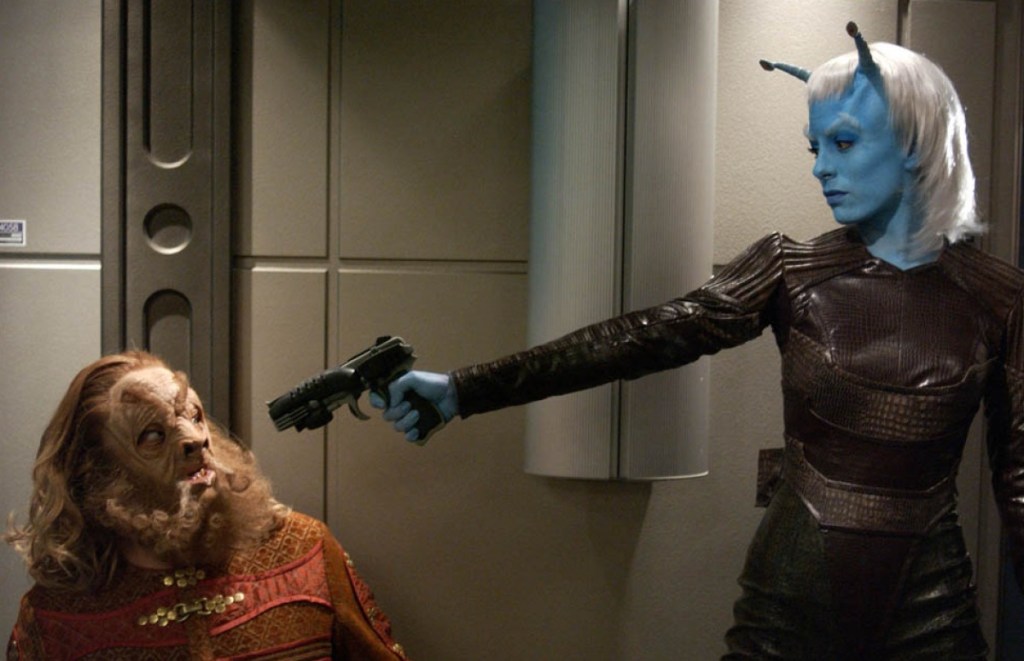
As was the case with Deep Space Nine, in the years since Enterprise wrapped the critical consensus has shifted. Time, as well as the rise of streaming television, have helped to rehabilitate its image. However, in the years since its unceremonious cancellation, there has been much debate on just what was responsible for its downfall. As I mentioned at the beginning of this post, there are many culprits.
When rewatching it today, I’ve come to feel part of it relates to its awkward place in sci-fi history. Enterprise came along at a time when cultural norms, particularly with regards to television representation and storytelling, were evolving. Particularly in how it handled female characters (notably T’Pol), the series now feels insensitive and dated. But ultimately, I believe the biggest issue was simply this:
For most of its run, Enterprise just couldn’t figure out what it wanted to be.
The decision to exclude the words “Star Trek” from its original title was meant to send a message: this is going to be completely different. But the title, and the show’s early storylines, proved confusing and at times frustrating to longtime Trekkies. When the show premiered, fans longed to see the formation of the Federation, perhaps including the Romulan War mentioned in the original series. Instead, the early seasons largely paid lip service to the show’s established alien races. The initial “Temporal Cold War” story arc grew increasingly convoluted. And the third season’s Xindi arc, which introduced a completely new species and showed paragon of virtue Archer making increasingly ugly decisions on a quest for revenge, turned many fans off entirely.
Ultimately, it took until the show’s final season (which came after it had already been cancelled) for showrunners to embrace the Trek label. Many of that season’s story arcs tied directly into the original series, showing the establishment of a new Vulcan government, Starfleet’s search for a location for its first starbase, and ultimately the early stirrings of the Federation. But while these storylines were tantalizing, they came too little, too late to save the show. And in the end, fans were left to wonder what might have been.
In the end, the failure of Enterprise and the film Star Trek: Nemesis flopping at the box office, forced the franchise into a long-overdue full rebuild. The property came under new leadership, and through a process that began with 2009’s Star Trek film and culminated with the 2017 premiere of Star Trek: Discovery, the franchise was finally reborn. Enterprise thus leaves a complicated legacy, simultaneously both the last gasp of Trek‘s long era of dominance and the originator of many modern conventions in sci-fi television. It’s possible that the writers bit off more than they could chew. It’s equally possible that sci-fi viewers just weren’t ready for a series like Enterprise.
Or, it could be that the showrunners ignored one of the many famous Shakespeare lines quoted throughout Trek‘s history: “This above all else; to thine own self be true”.
All four seasons of Star Trek: Enterprise are currently available for viewing on Paramount+.
 Michael T. Kuester