Look, objectively, science fiction can be pretty funny. It leans heavily on tropes and cliches. While at its best it can be deep and introspective, most casual fans immediately think of the crew of the starship Enterprise, clad in brightly-colored shirts with gold piping, listening to Captain Kirk’s overly-dramatic speeches as he dodges paper mâché boulders thrown by aliens with visible zippers.
I know better than anyone how hard it can be to not take yourself too seriously as a sci-fi writer. Sometimes, you really need to laugh. And in her novel All Systems Red, longtime Star Trek fiction writer Martha Wells delighted in poking fun at her favorite genre.
This is a sort of milestone post for me, as I’m writing a review of a television series based on a novel I also reviewed. And I’m pleased to say, anyone who loved All Systems Red (as I did) will love season one of Murderbot for all the same reasons. Apple TV+ has grown into arguably the ultimate platform for sci-fi fans, but while Foundation very much falls into the overly-serious range of the genre, Murderbot lies at the opposite end of the spectrum. So this month in “Sci-Fi Reviewed”, let’s take a look at Murderbot: what it’s about, why it works, and how Apple managed to pull off the perfect adaptation of the sci-fi book that makes fun of sci-fi.
The Premise
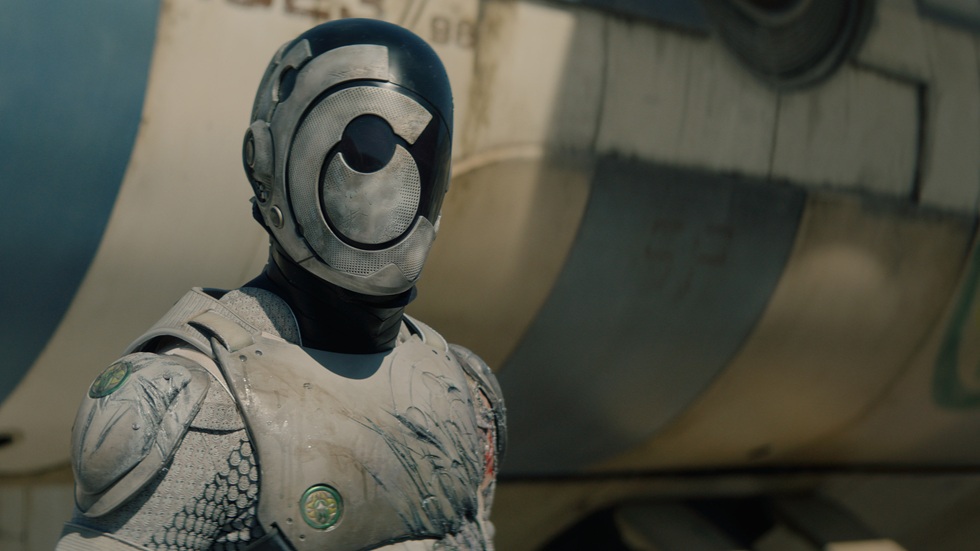
Murderbot revolves around a rogue “security unit”; basically a corporate rent-a-terminator. In the series’s dystopian future, security units are cyborg soldiers contracted to prospecting expeditions to protect their clients. They’re programmed to obey every order from the clients, controlled by what’s known as a governor module. Unbeknownst to its operators, however, the titular character has hacked its motivator, and is now a free agent, calling itself “Murderbot”.
Now, there are plenty of stories in science fiction about artificial intelligence overcoming its programming. Usually the intelligence goes berserk (think HAL 9000). But despite being heavily-armed, Murderbot doesn’t use its newfound autonomy to seek vengeance or go on a violent rampage.
Mostly, it uses it to watch hours and hours of trash TV.
Murderbot realizes its operators would melt it down if it were discovered to have overcome its governor. So it just plays along, going through the motions of its bloody work while downloading and watching various entertainment feeds. Eventually, its work as a sec-unit leads to its assignment to a planetary survey mission from Preservation Alliance.
Preservation lies beyond the “Corporate Rim”: the region of space largely controlled by a dystopian mass of competing business interests, where indentured servitude is a way of life, everything’s for sale, and anyone will do pretty much anything for money. It isn’t long before Murderbot realizes his new clients aren’t like other humans he’s met. The products of a classic sci-fi utopian society that makes Star Trek‘s Federation look capitalist and tyrannical by comparison, they’re depicted as space hippies. It isn’t long before they begin to bond with Murderbot. Unaware of its autonomy, they debate the morality of what they consider its enslavement, and treat it as a member of their team.
While this feels touching for viewers, at first Murderbot mostly finds it annoying. As in the novel, it frequently comments on how stupid humans tend to be, mocking their attempts to anthropomorphize it (and wondering why it would ever want to be treated as human). Much of the story depicts Murderbot’s increasingly frustrated efforts to prevent his well-meaning but naive clients from getting themselves killed.
The Response
Currently, season one of Murderbot holds a 96% fresh rating on Rotten Tomatoes. Though some critics disliked the show’s tonal departure from the novel, most lauded the show’s comedy. In particular, Skarsgård was praised for the dry wit he brought to the title character.
My Take
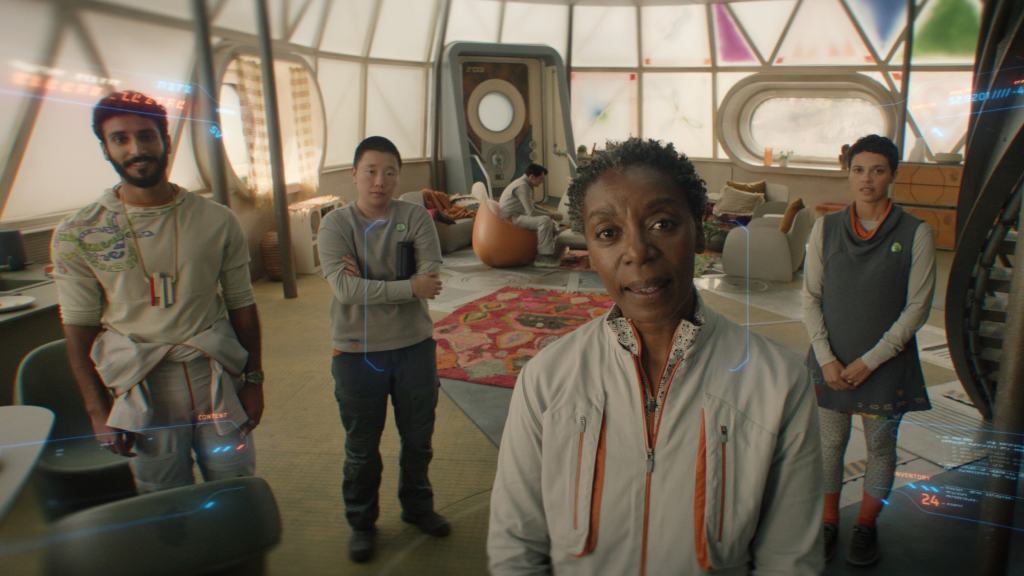
The first thing I tell people about Murderbot is that it’s been decades since I’ve seen such a faithful adaptation of a novel. Skarsgård does a masterful job of capturing Murderbot’s cynical view of humanity, particularly the sometimes misguided altruism of his clients. His clients initially threw me for a loop; the touchy-feely Bohemian tone of their group felt even more ridiculous than their more Star Trek-inspired portrayal in the novel. However, though that aspect of their characters changed, if anything I feel it only underscored the message: sci-fi sometimes takes itself way too seriously.
As I mentioned in my review of All Systems Red, the heart of this story is all-out mockery of long-standing sci-fi tropes. As in the book, the well-intentioned actions of the Preservation team frequently land them in unnecessary danger. Often they barely survive, and spend some time patting themselves on the back while Murderbot comments on how stupid they are. But despite everything, the viewer follows Murderbot’s arc as they learn to truly like its clients. Their morality may nearly get them killed, but they never give in. They keep fighting for Murderbot’s agency, and ultimately give it something it could never have dreamed of: its freedom.
I often joke that I say “thank you” to virtual assistants like Siri and Alexa because when AI becomes fully self-aware, I want it to remember who was nice. There’s a lot of justifiable fear surrounding AI today. But if we can find enough people like the Preservation team, well, maybe we’ll be okay. – MK
The first season of Murderbot is currently available for viewing on Apple TV+. Season Two has already been announced, with an expected release date of 2027. In next month’s “Sci-Fi Reviewed”, I’ll be reviewing the Apple TV+’s acclaimed series Severance.
 Michael T. Kuester