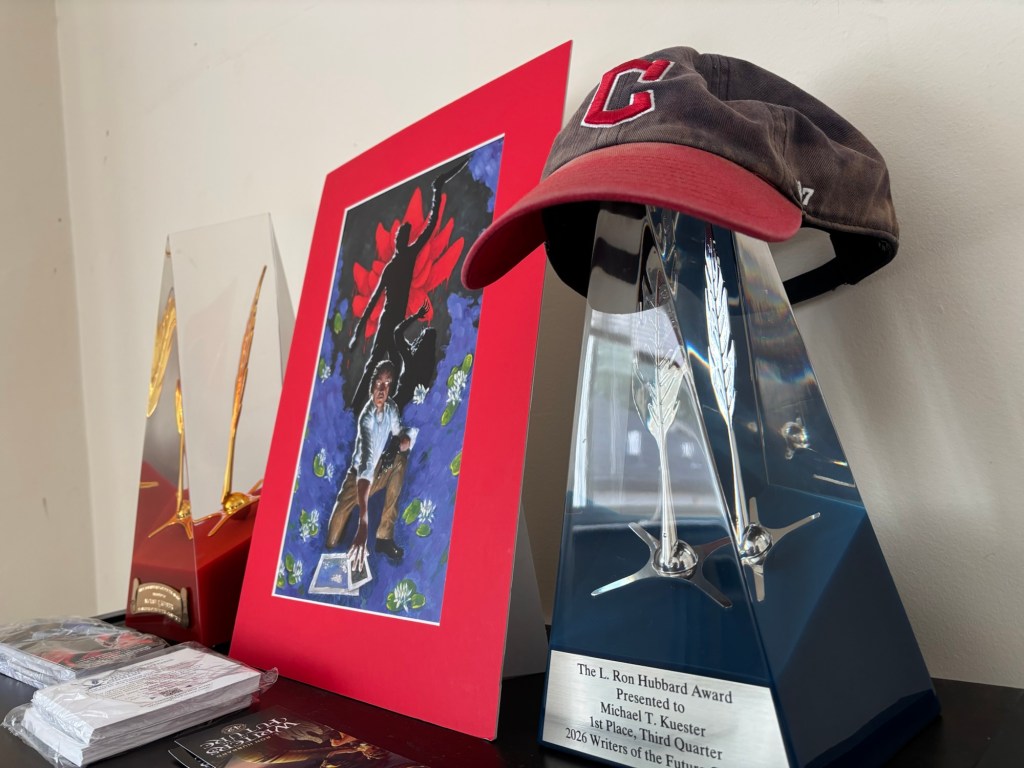
On Discord, there’s a dedicated server for all past winners of Writers of the Future. It’s a place where we can exchange information on the publishing industry, critique one another’s work, and build our writing careers together. Mere days after my first-place win was announced, two winners reached out to me with an invitation.
On the server, one of the channels is simply titled, “Your Joni Calls”. Because that’s how it starts: a call from contest director Joni Labaqui, informing you that you’re a finalist in the current quarter. The channel serves as a sort of introduction for new winners, as well as a chance for them to express the waves of emotions that come with learning you’ve won.
Every winner’s story is different. This is mine. And it involves years of frustration, one miserable week, a lot of supportive readers, and an unexpected phone call on a chilly September night.
The Contest
Literally the first question every single person involved with Author Services (which runs the contest) asked me was “How did you learn about the contest?” And every time I answered truthfully: I was looking for literally any way to further my stalled writing career. After entering in 2021 I’d forgotten about the contest. Then, in 2024, I was listening to a podcast in which a debut author said she’d gotten her start by winning a contest. So I did a quick internet search for “Sci-Fi Writing Contest”, and lo and behold, Writers of the Future was at the top of the list. It looked too good to be true (when I said that to staff at ASI, the response was invariably “We get that a lot.”). I’d found a new market to submit my short fiction to. And by that point, I had a lot of it.
I began 2025 on a hot streak: between November 2024 and February 1, 2025, I completed five short fiction pieces, most of which were written in January. Not only that, but these were good pieces. When one of them netted a personal rejection from Analog, I was eager to strike while the iron was hot, and I remembered Writers of the Future.
I submitted “Prishelets” with thirty minutes to spare on the first quarter deadline. That netted me an honorable mention. The following quarter I submitted “Casual Brutality”, a story that will be appearing in the July/August issue of Analog. That one received a Silver Honorable Mention from Writers of the Future.
The Story
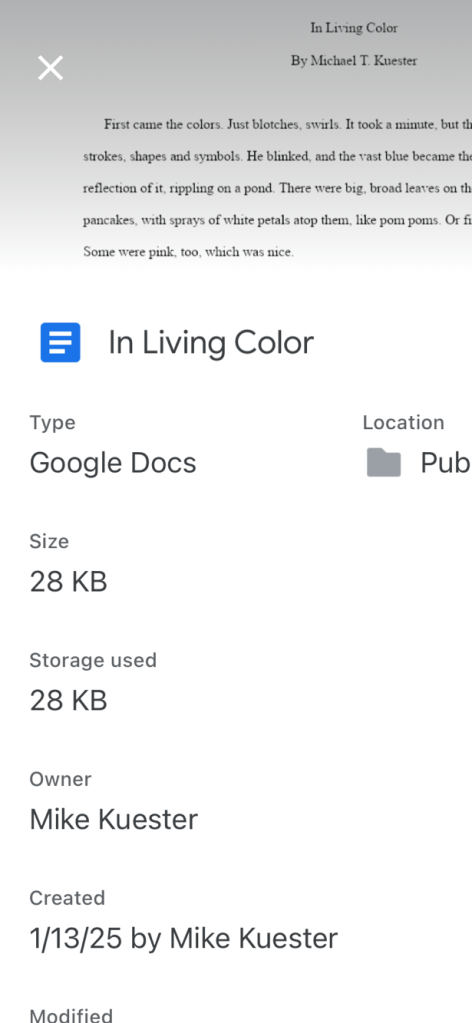
On the morning of January 13, 2025 (a Monday), my morning sketch began with a man stepping into a painting and taking a stroll through Monet’s garden. As tends to be the case, I wrote whenever I could throughout the day. By lunchtime, I knew his name was August, and he analyzed crime scene photographs for the police. That evening, I took the sketch and dumped it its own file, because it was a story now. By that point I knew August lived in Cincinnati (setting it in my hometown helped me get all the details without research) and that he and his detective friend were tracking a serial killer.
Stories need titles, so I called this one “In Living Color”, figuring I’d probably change it half a dozen times anyway.
My longtime readers may actually remember this story. It was the one that made me miserable. I hated it. It kept getting darker and more upsetting. I grew withdrawn, stopped talking to my friends, got snappish around the house. By the third day I was having nightmares. Not about what was going on in the story, but I hadn’t had a nightmare in years. I knew what was causing this. By Thursday I was telling friends how eager I was to finish the story. I compared writing the story each night to navigating a sinking ship: holding my breath as I swam through flooded corridors, desperately seeking a way out.
By Saturday night, I’d written “The End”, and was glad to be rid of it. I couldn’t wait to get back to writing hard sci-fi space adventure like I always want to. I put the story aside for almost a month, partly because I really didn’t want to go back to it. But eventually I got around to editing, and once I did, I showed it to my beta readers. A couple of them had really been looking forward to it (the words “telepathic serial killer” seemed to pique their interest), but I was pretty sure they’d be disappointed. And I was certain this was an unmarketable story. It crossed boundaries between speculative subgenres. It didn’t fit neatly into any box. It was grim, it was gory. It was dark, twisted, and violent.
And all of my beta readers loved it.
It’s worth noting that this was the story that formed my beloved beta group. These wonderful individuals united over their collective love for “In Living Color”. Frankly, I was shocked at the response, though more than likely that came from my own personal feelings toward the story. I still associated it with sleepless nights and misery.
When the third quarter submission window for Writers of the Future opened, initially I was planning to submit “Saints of Armageddon”, as I’d been submitting stories in the order in which I’d written them. However, by that time began I’d just submitted that story to Strange Horizons (it was ultimately rejected). So, I skipped to the next one on the list, and submitted “In Living Color”.
Suffice to say, I didn’t like my chances. Good or bad, I worried the story wasn’t going to go over well: a grim, bloody speculative noir heavy on murder. I spent a lot of time carefully reading the section of the contest rules about “graphic violence”. But the truth was, based on what I knew about the current literary market, I didn’t feel like I had any other options. This story was too dark and violent for most sci-fi pubs, to sci-fi for horror. Too speculative for mystery or thriller. If it had been rejected by the contest (as I expected it to be), my plan was to toss it into my trunk and forget about it.
But the judges of Writers of the Future had other plans.
The Calls
By August, Analog had been holding on to “Casual Brutality” for almost four months, and I was increasingly confident that it would be picked up. Realizing I might end up being published while “In Living Color” was still under consideration with Writers of the Future, I reached out to the contest in a panic asking if I’d need to withdraw my story. My email was fielded patiently by the contest director, who reminded me that the rules required three professional publications before disqualification, not one.
That was how I first came into contact with Joni Labaqui.
By late September, I knew the judging on the third quarter was nearing completion. Fully expecting a rejection, not even an honorable mention, I’d already submitted “The First Night on Eridani” for the fourth quarter. Believe it or not, under normal circumstances I seldom receive phone calls from a Los Angeles area code at 8 PM on a Saturday, so…I let it go to voicemail. I was watching football when I suddenly realized the call might have come from the contest. My first thought was that they were calling me because of just how dark and violent “In Living Color” was. I expected to listen to the voicemail and hear, essentially, “Look, we appreciate your efforts to win the contest, but please don’t send us anything like this again. Ever.”
Instead, I read the transcript and saw it began,
“Hi, Michael. This is Joni Labaqui from Writers of the Future! Yes, I am calling you at eight o’clock on a Saturday night, I know. But I’m excited, and I have exciting news…”
Joni, if you’re reading this, I’m sorry it took as long as it did for me to call you back. I couldn’t call right away, because I was crying.
For anyone reading this who isn’t a writer, you should know that the hardest part of launching a writing career is what industry professionals call the Invisible Work. Before you become a professional writer, you spend years of your life learning, researching, and writing. Rejections pile up, blog posts are ignored, and you spend all your time screaming into the void. But in that moment, finally, I learned that someone had listened.
All the years of struggle, all the impostor syndrome, all the long nights and cups of coffee and pots of Earl Grey tea, came crashing down on me like a wave. And for the first time since I got this crazy idea to make a career out of writing, I let myself feel the years of pain and frustration and hopelessness. Telling people I was “The best writer nobody’s ever heard of”. Wondering just how much more of myself I had to pour onto the page just to move the needle an inch. I’d built a dam to hold it all back, didn’t allow myself to really feel it. I knew that if I let it in I’d drown in despair. And only when I realized I’d finally made progress did I realize just how much I’d kept myself from feeling.
That call was a page break. Chapter over. New chapter.
When I finally returned Joni’s call, she was on the phone with someone else, and told me she’d call back soon. What followed was what I’ve come to call the longest forty-five minutes of my life. September Saturdays mean college football, but I couldn’t concentrate on any of the games. By the time Joni called back, I’d done enough frantic, obsessive internet sleuthing to have a pretty good idea of what she was about to say: that I was a finalist for the third quarter.
The entire call was surreal. Joni asked about my writing process, about how I wrote “In Living Color”. I told her, truthfully, that the story had ruined a week of my life. She started name-dropping authors whose work I’d grown up with. She compared me to Larry Niven. And she told me that, while she had yet to read my story, many in her office had, and everyone was talking about it.
I was one of eight finalists for the third quarter. If I took first, second, or third place, I’d receive a cash prize and a paid publishing credit. She told me about the Writers of the Future workshop I’d be flown out for if I won, but to be honest, I didn’t pay much attention to that. It was too much to hope for. After making it as far as I had, having struggled for so long to be noticed, wanting to win felt greedy.
Joni ended the call by telling me I’d hear back in about a week, after the judging had been finalized. So I waited. When you’re a writer, even a successful one, you wait a lot. I was used to that. But this was different. On my morning walks, rather than listening to podcasts or music I kept telling myself that I’d already accomplished a lot. Just being eighth place out of hundreds, perhaps thousands, was a big deal. A huge step forward. I wasn’t allowed to say anything publicly (in the writing business, we call this being vague: you have big news but aren’t permitted to disclose it yet). But over the course of the week, I composed a “Concession Speech” for my blog and my Twitter followers. Telling everyone that I was grateful to have been named a finalist. That this was a validation, and would propel me onward.
I never did get to deliver that speech.
The following week, again late at night, I got the call. Being me, I’d spent the previous several days wondering what the timing of the call would mean. Would they call the first place winner first, so they weren’t tipped off by other finalists saying “I won third place!” or “I won second place!”? Would they call first place last, so other finalists didn’t see the winner gushing and realized they’d lost? Well, it didn’t matter. And perhaps the nicest thing Joni did for me throughout this entire process was not keep me in suspense. The first thing she told me is “You won first place.”
That night I laughed. I jumped up and down. I cried. I called my parents. I had a glass of wine. And then I sat down and wrote a new story. Because when you’re an aspiring writer, that’s what you do. Ever forward.
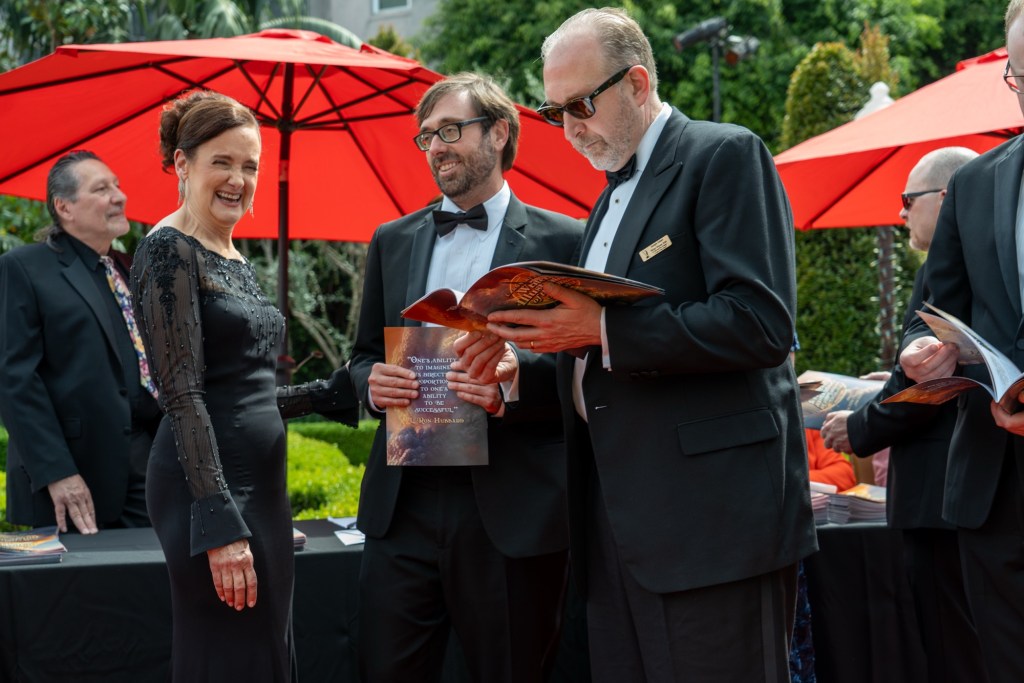
If you read my blog or follow me literally anywhere, you know the rest. Months of editing. A week in Hollywood. A glamorous award ceremony where I received the trophy I was expecting, then another I hadn’t dared to hope for. Since then it’s been interviews and podcasts, bookstore visits and signings scheduled. And a lot of blog posts, like this one. This was originally supposed to be a post on how I won the contest. But as I wrote about the lead-up, the calls, and the week in between them, I realized I needed to make this a separate piece. Because as I was writing it, all the emotions bubbled back up to the surface, and I realized I needed to share this on its own.
Over the course of August, as I’d waited to hear back from Analog and Writers of the Future while preparing for my first round of queries, I began listening to a song by the Royal Philharmonic Orchestra, called Day of Why. It led to a new personal mantra in my writing:
Why not me?
I’d put in the work. The time and the effort. I’d struggled for so long, and had just spent nearly a year plugging away furiously, reading and writing constantly to up my game. By August I knew I was close. I could feel it. But years of experience had told me it wasn’t going to happen. Not now. Not yet. So, I flipped the script and started asking, “Why not now?”
As I sat on that September night with my phone in my hand, sobbing from all the pent-up pain and fear, I was listening to that song, over and over and over. September 20, 2025, became my Day of Why. Of why not.
This has been one of the longest posts I’ve written in years, but anything you write should only be as long or as short as it needs to be. So for those who’ve stuck with me, I’d like to give one simple message to all the writers out there, reading this and wondering if they’ll ever break through:
Don’t give up.
I know it’s hard. There are days when everyone around you wonders why you’re still doing this. How you could possibly succeed. I know you’ve written stories that you thought were really good. That would absolutely land your name in print. And one after another you submitted them and they struck out.
But your first winning story is waiting for you. Maybe you haven’t written it yet. Or maybe it’s sitting on your hard drive, in preparation for the big moment when you send it to someone and they drop everything to read it.
Your story is important, and only you can tell it. This is my story.
Now go and write your own. —MK
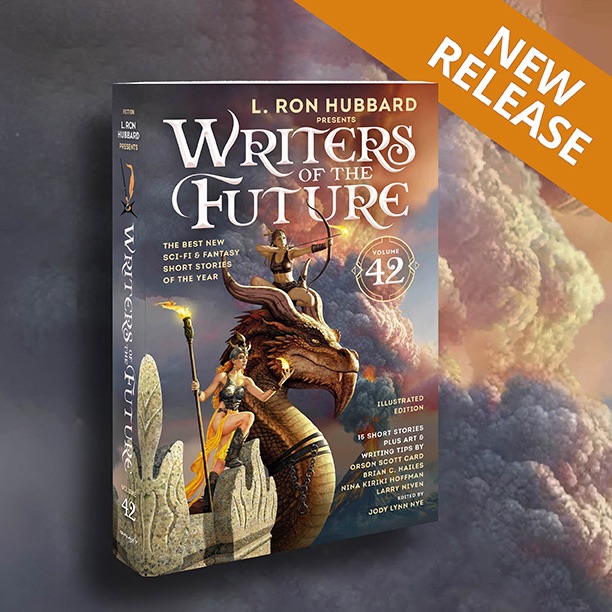
Writers of the Future, Vol. 42 is now available, featuring my award-winning story “In Living Color”. Click here to learn more, and order your copy.

 Michael T. Kuester
Leave a comment