
One year ago today, I found out I was going to be a published author.
I’d been on the edge of my seat for over a week, after Joni Labaqui had called late on a weekend night to tell me I was a finalist for the third quarter of the Writers of the Future contest. Then, on the night of September 29, she called again. I’d won first place.
While it had been less than a year since I’d buckled down and focused on growing as a writer, I’d been writing on and off for over a decade. Amid those fits and stops, I’d submitted stories to various literary magazines, compiling a list of rejections. Finally, on that chilly September night, I received what I’d been searching for: recognition. Publication. Acceptance.
Less than two weeks later, I received another publishing credit, when Analog bought my story “Casual Brutality”. It was an unprecedented run of success. Two stories picked up in less than a month.
A year on, I’ve seen my work in print twice. And just last week, I sold my third story, this time to Asimov’s. I have another ten stories out on sub, several of which have been out there long enough that there’s a good chance they get picked up. My run of success continues.
And yet, while those around me relish my success and lavish me with praise, my general response is, “Okay, I got another one. What’s next?”
Making Excuses for Success
The thing is, try as I might, I haven’t been able to really see my accomplishments as truly impressive. Subconsciously I’ve managed to minimize every one as they’ve come along.
After winning Writers of the Future, all I could think was, “Sure, I won first place. Just like three other people this year.” Three people. Out of thousands. In perhaps the most prestigious competition reserved solely for previously-unpublished writers of genre fiction.
When I sold a story to Analog, I found myself looking at their acceptance rate, which at the time sat just north of three percent. I thought, “Three percent? So that’s how I got in. They’ll take pretty much anybody.” The oldest continually-running sci-fi literary magazine. The one that gave Frank Herbert and Orson Scott Card their first big breaks. What’s worse, I’d been accepted at the time of year when they send out the majority of their acceptance letters. That three percent was heavily skewed.
Then, just last week when I was finally accepted by Asimov’s, I started telling myself it only happened because their current interim editor-in-chief knew me from Analog. The longtime senior managing editor of another prestigious magazine. One who’d spent years working alongside the legendary Sheila Williams. And to top it off, I’d managed to conveniently forget that, even if she had accepted me simply because of her work at Analog (vanishingly unlikely), that still meant my story with them had left a lasting impression.
It wasn’t until this weekend that I finally asked myself, “What the heck is wrong with me?”
Am I afraid to admit I’m finally getting noticed?
Am I hellbent on believing I’m a third-rate hack who’s fooling everyone?
The Numbers
On average, an active short fiction writer can expect to publish no more than four or five stories per year. And that’s stories of any length. It’s generally easier to publish stories at lower word counts, partly because such stories can be written quickly, and partly because the market for shorter works is broader and more open.
For stories around my average length, around 10-15k words, the market is much tighter. Consider this: the majority of major sci-fi literary magazines currently publish six issues per year. While each issue may feature six or more shorter pieces, they’ll only contain, at most, three novelettes, and only one novella. That means writers who produce the length of stories I work in may be competing to have their story be only one of six such works published by a magazine in a calendar year.
And it’s a fact that the market for genre short fiction has never been tougher. Most markets have been receiving higher and higher volumes of submissions over the past several years. New magazines are popping up all the time, and still they find themselves inundated with submissions.
So, yeah. I’ve sold three stories over the past twelve months. It doesn’t sound like much. It doesn’t feel like much. Fellow writers reading this have probably already divined an explanation for this, and it’s two words long: imposter syndrome.
A Sense of Randomness
The truth is, I think all of this keeps feeling unearned to me because it’s all happened so fast. Last year at this time, beyond my closest friends and my critique group, every fan I had worked in the offices of Author Services, Inc., which runs the Writers of the Future contest. I’m a math guy who loves baseball; small sample sizes are easy to dismiss. Twelve months on, I’m seeing sci-fi afficionados post reviews of my Analog story on social media.
When you’ve toiled in obscurity for so long, a sudden string of successes can feel random. I look at where I am now, and can’t shake the feeling that I’m punching above my weight class. That somehow my writing has outpaced my name recognition. And I do think that plays a part in all this: the sense that all of this just happened, without the grueling, continuous struggle you’d expect.
But there’s one more aspect to my feelings toward my publications: a sense of incompleteness.
“Dream not of today.”
Every time I’ve netted a publishing credit (all three of ’em now), all my friends, writers and non-writers alike, have said, “You should take some time to celebrate!” And every time, I’ve instead sat down that very night and written something new. Because, as I’ve said many times about winning Writers of the Future, once I’ve sold a story, it becomes part of my past. It’s not something I’m doing, it’s something I’ve done.
Since “Casual Brutality” was published in Analog this past summer, I’ve adopted a personal motto every time I hit a writing milestone: “Dream not of today.” It’s a quote from “The Chase”, one of my favorite episodes of Star Trek: The Next Generation, and it wasn’t until I was rewatching the series as an adult that I fully understood its meaning.
Don’t dream of today. Today has already happened. Dream of tomorrow, and all the possibilities it still holds.
Succeeding as a writer is about moving the goalposts. Take a moment to appreciate your successes, but only a moment. Because there’s always a “next thing”. The next story. The next submission. The next publishing credit. When you’re an author, there’s never an endpoint. In the words of CeCe Lyra, “There is no champagne room”. So stay hungry. Never let yourself feel complete. And always remind yourself that, however impressive your accomplishments may be, the world hasn’t seen your best yet. – MK
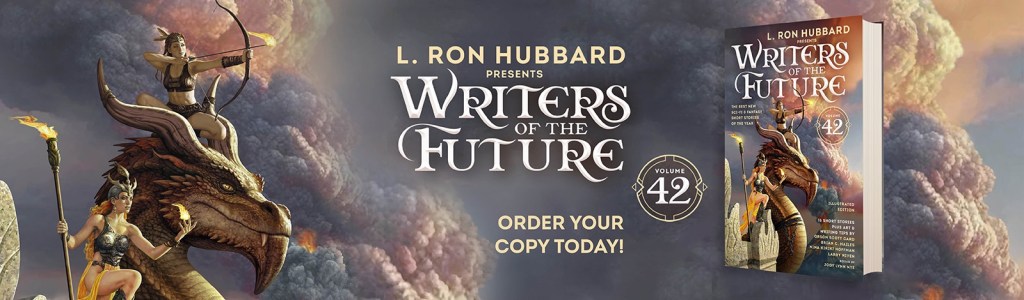
Writers of the Future, Vol. 42 is now available, through Amazon and wherever fine literature is sold. It includes my winning story, “In Living Color’. It was the best story I’d ever written. But my best is still to come.




Leave a comment